


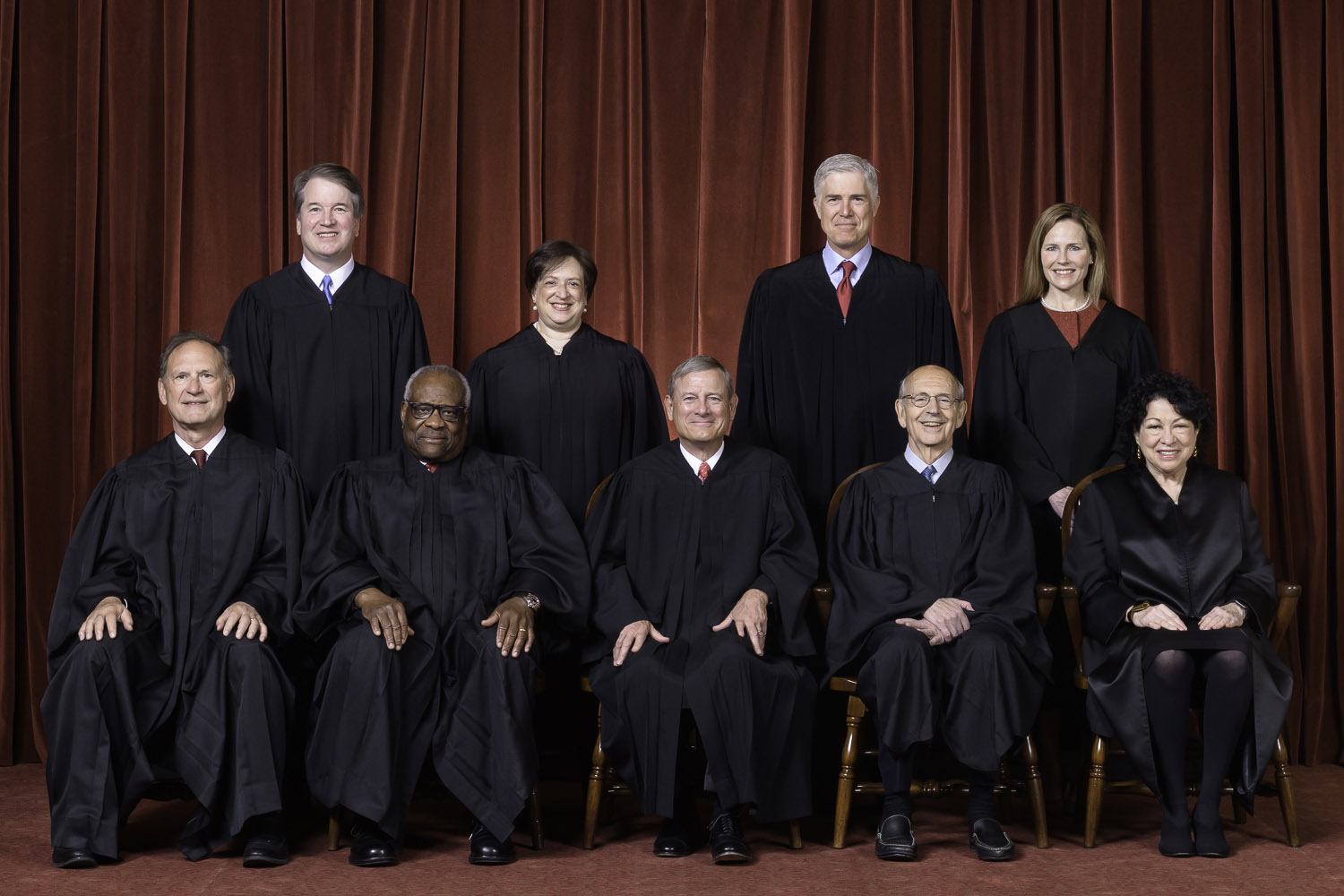
FDR declared that December 7th, 1941, the day that Pearl Harbor was attacked by Japan, would live in infamy. But December 11th, 2020 will have more repercussions by far than Pearl Harbor. It was on that day that the Supreme Court shirked its responsibility when it refused to hear the case of the State of Texas versus the Commonwealth of Pennsylvania, State of Georgia, State of Michigan, and the State of Wisconsin.
By refusing to rule on a subject that is clearly defined in our Constitution that says that state legislatures have the power to set election rules by which the Founding Fathers put in there to keep the sovereignty of states, Chief Justice John Roberts changed the course of history and not for the better. It was an act of pure cowardice. The Supreme Court was created mainly to rule on cases that have to do with determining if a law is constitutional or not. Because they failed to act, bad actors in powerful positions continue to make new rules without consulting the legislature.
From The Constitution:
Article I Legislative Branch
-
Section 4 Congress
- Clause 1 Elections Clause
-
The Times, Places and Manner of holding Elections for Senators and Representatives, shall be prescribed in each State by the Legislature thereof; but the Congress may at any time by Law make or alter such Regulations, except as to the Places of chusing Senators.
- ArtI.S4.C1.1 Historical Background on Elections Clause
- ArtI.S4.C1.2 States and Elections Clause
- ArtI.S4.C1.3 Congress and Elections Clause
- Clause 2 Assembly
-
The Congress shall assemble at least once in every Year, and such Meeting shall be on the first Monday in December, unless they shall by Law appoint a different Day.
- ArtI.S4.C2.1 When Congress Shall Assemble
The case was so simple that even a Democrat can understand it:
VISIT OUR YOUTUBE CHANNEL1. The U.S. Constitution is the foundation of all other laws in the United States. Everything that happens in the U.S. is governed by the U.S. Constitution. It is the one law that reigns over all other U.S. laws. The Constitution clearly states the rights and authority of the people of the United States and the various branches of its government. In other words, it tells us who has the authority and power to decide what happens in our country at the individual (or personal), state, and national levels.
2. Article I, Section 4 of the Constitution tells us who makes the rules regarding national elections: “The Times, Places and Manner of holding Elections for Senators and Representatives, shall be prescribed in each State by the Legislature thereof. . . .” In other words, the Constitution gives the authority over national elections to the legislatures in each of the states.
3. In the 2020 election, there were at least four states (Pennsylvania, Georgia, Michigan, and Wisconsin) in which the state executive branch (that is, the governor or other executive official) and/or the judicial branch (that is, the state supreme court) changed the rules of the election apart from the authority of the state legislature. These actions were a direct violation of the U.S. Constitution, which grants this authority only to the state legislatures.
4. The result of this constitutional violation was that the results of the 2020 national election were changed from what they would have been if U.S. constitutional law had been followed.
5. The State of Texas, along with 17 other states and 126 members of the U.S. House of Representatives, called out the four states that had violated the Constitution and challenged their election results as being unlawful. They filed their case with the U.S. Supreme Court. In other words, about 20% of the states and about 30% of the House of Representatives joined together with Texas and went to the Supreme Court to say that this was wrong, and that these four states broke federal law and changed the election.
6. The U.S. Constitution is very clear about the types of cases the Supreme Court should decide. It starts by describing the kinds of cases in which the Supreme Court has “original jurisdiction.” These are the cases that can only be brought to the Supreme Court to decide. In Article III, Section 2 of the Constitution, it says that “The Judicial Power shall extend to all Cases, in Law and Equity, arising under this Constitution, the Laws of the United States, and Treaties made, or which shall be made, under their Authority; . . . —to Controversies between two or more States. . . .” The kind of case that Texas was bringing, along with several other states and over a hundred congressmen, was a case in which the Supreme Court had original jurisdiction. In other words, the Constitution tells us that this is the kind of case that the Supreme Court was designed to hear, and also that there is no other court in the entire world that has the authority to hear and decide this kind of case.
7. The Supreme Court refused to hear and try this case. The most likely reason is that the nation was severely divided and in turmoil, and the Court was too timid, too reluctant to risk the fallout and do its rightful duty. The U.S. Constitution was clearly violated—any average middle schooler could see and understand that. The results of the national election were affected by these violations. The Supreme Court was created and specifically designed 234 years ago to hear these kinds of cases. In other words, this case fell squarely in the middle of the Supreme Court’s job description. It is an integral part of the Supreme Court’s very purpose to hear and try this type of case.
However, the violations of the U.S. Constitution by the states of Pennsylvania, Georgia, Michigan, and Wisconsin are indisputable. These violations are a matter of public record. No fact checker in the world can change the fact that U.S. state executive branches and state courts usurped their state legislatures in these four states and, in doing so violated the U.S. Constitution, and that subsequently the results of the 2020 national election were unlawfully altered.