





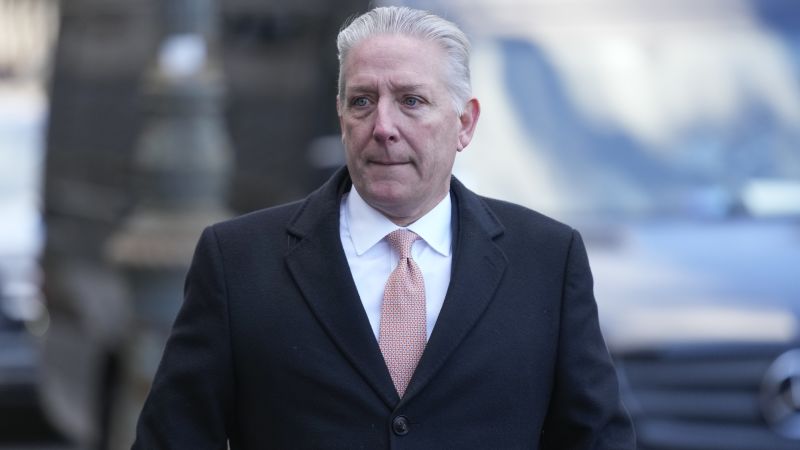
Now, isn’t that ironic. The man who investigated Trump knowing it was a hoax will be wearing an orange jumpsuit for doing what the FBI was accusing Trump of doing. Charles McGonigal, once the Special Agent in Charge (SAC) of the FBI’s Counterintelligence Division in New York has been convicted of money laundering and for conspiring to violate the International Emergency Economic Powers Act (IEEPA). In other words, he was working for Russian oligarchs including Oleg Deripaska, a Russian oligarch sanctioned by the U.S. government.
McGonigal (No relation to Professor McGonigal of Harry Potter fame) worked with Deripaska in an attempt to get him off the sanction list in order to allow him to come to the United States back in 2019.
U.S. Attorney Damian Williams for the Southern District of New York said:
“After his tenure as a high-level FBI official who supervised and participated in investigations of Russian oligarchs, Charles McGonigal has now admitted that he agreed to evade U.S. sanctions by providing services to one of those oligarchs, Oleg Deripaska.”
“This office will continue to hold to account those who violate U.S. sanctions for their own financial benefit.”
Assistant Attorney General Matthew G. Olsen of the Justice Department’s National Security Division added:
VISIT OUR YOUTUBE CHANNEL“Charles McGonigal, by his own admission, betrayed his oath and actively concealed his illicit work at the bidding of a sanctioned Russian oligarch.”
“Today’s plea shows the Department of Justice’s resolve to pursue and dismantle the illegal networks that Russian oligarchs use to try to escape the reach of our sanctions and evade our laws.”
Read the DOJ’s press release:
In 2014, the President issued Executive Order 13660, which declared a national emergency with respect to the situation in Ukraine. To address this national emergency, the President blocked all property of individuals determined by the U.S.
Treasury to be responsible for or complicit in actions or policies that threatened the security, sovereignty, or territorial integrity of Ukraine, or who materially assist, sponsor, or provide support to individuals or entities engaging in such activities. Executive Order 13660 and regulations issued pursuant to it prohibit providing or receiving any funds, goods, or services by, to, from, or for the benefit of any person designated by the U.S. Treasury.
On April 6, 2018, the U.S. Department of the Treasury’s Office of Foreign Assets Control (OFAC) designated Oleg Deripaska as a Specially Designated National in connection with its finding that the actions of the Government of the Russian Federation with respect to Ukraine constitute an unusual and extraordinary threat to U.S. national security and foreign policy.
According to the U.S. Treasury, Deripaska was sanctioned for having acted or purported to act on behalf of, directly or indirectly, a senior official of the Government of the Russian Federation and for operating in the energy sector of the Russian Federation economy. The U.S. District Court for the District of Columbia affirmed the sanctions against Deripaska. It found, among other things, that OFAC’s determination that Deripaska acted as an agent of Russian President Vladimir Putin was supported by the evidence.
As an FBI official, McGonigal helped investigate Deripaska and other Russian oligarchs. As a SAC, he supervised investigations into sanctions violations. Yet at the same time, he began building a relationship with an agent of Deripaska, in the hopes of doing business with Deripaska after he retired from the FBI.
In 2021, McGonigal conspired to provide services to Deripaska, in violation of U.S. sanctions imposed on Deripaska in 2018. Specifically, following his negotiations with Deripaska’s agent, McGonigal agreed to and did investigate a rival Russian oligarch in return for concealed payments from Deripaska.
While negotiating and performing services for Deripaska, McGonigal and the agent attempted to conceal Deripaska’s involvement by, among other means, not directly naming Deripaska in electronic communications, using shell companies as counterparties in the contract that outlined the services to be performed, using a forged signature on that contract, and using the same shell companies to send and receive payment from Deripaska.
McGonigal hoped to do millions of dollars in business with Deripaska, but FBI agents from the same division McGonigal used to lead foiled his scheme after only a few months of operation.


