





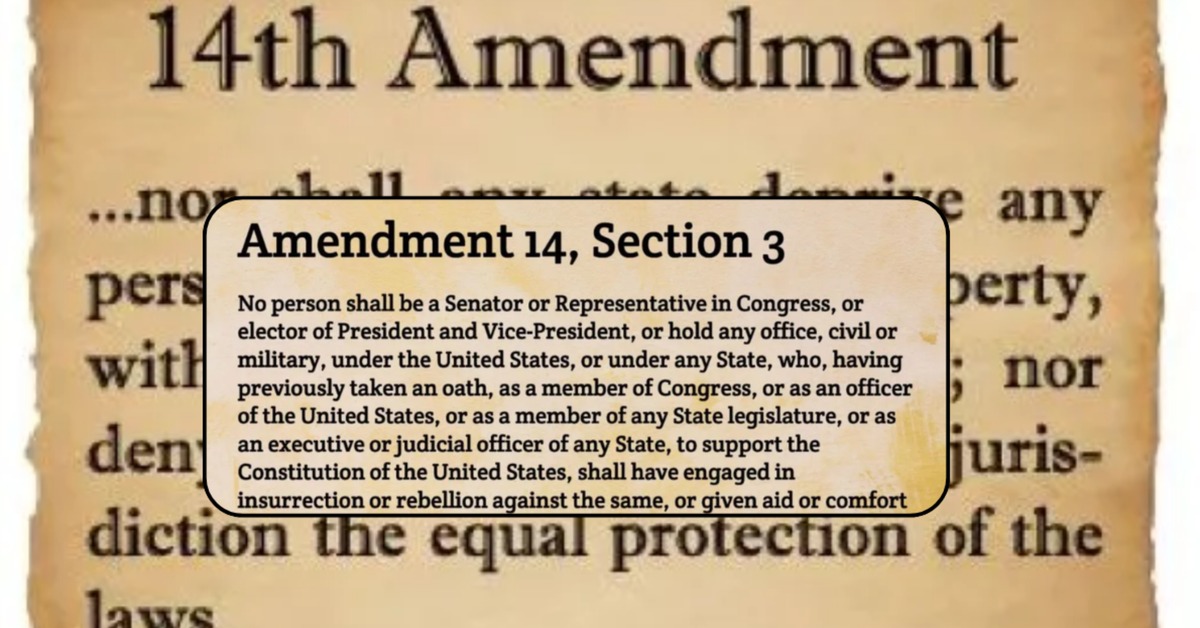
When it comes to political buzzwords, the 14th Amendment is having its moment in the spotlight. Specifically, people are talking about whether Congress could use it to block Donald Trump from taking office come January 20, 2025. The chatter centers on Section 3 of the amendment—yes, the one about insurrection and holding public office. Let’s break this down and see what all the fuss is about.
What Does Congress Really Have the Power to Do?
First, let’s address the elephant in the room. The Supreme Court in Trump v. Anderson made it clear that individual states can’t just whip out the 14th Amendment and decide who gets to be on their ballots. Whether you agree with it or not, Congress bears this responsibility. So, you have to ask yourself: Does Congress have a real case here? And what’s the deal with this amendment anyway?
The 14th Amendment: A Product of Reconstruction
To comprehend the 14th Amendment, you must travel back in time to July 9, 1868. The Civil War was over, slavery had been abolished by the 13th Amendment, and the nation was trying to rebuild. The 14th Amendment was part of this rebuilding process, aimed at securing rights for formerly enslaved people and redefining what it meant to be a U.S. citizen. In other words, the government was afraid that Democrats (former slaveholders) would try to create laws that dictated former slaves were not citizens because they were property before being freed by the Republicans.
Before the 14th Amendment, citizenship was a bit of a free-for-all—states set their own rules based on race, gender, and even property ownership. The amendment standardized things, ensuring “equal protection under the law.” Sounds good, right? But as we’re about to see, Section 3 opened a whole other can of worms.
Section 3: The “Insurrection” Clause
Here’s the gist of Section 3: if someone swore an oath to uphold the Constitution but then got involved in an insurrection or rebellion, they’re barred from holding public office. Congress can lift this ban with a two-thirds vote in both the House and Senate, but good luck getting that kind of consensus these days.
Section 3 was written to keep former Confederates out of power. Men like Jefferson Davis and other past members of Congress who participated in the insurrection. But today, some are wondering if it could apply to Trump, especially after the events of January 6, 2021. Let’s not forget—Trump was impeached by the House for incitement of insurrection but acquitted by the Senate because they couldn’t hit the two-thirds vote threshold. So, does his case meet the standard for “insurrection”? Note that Trump was never indicted for insurrection. The answer is ultimately no, but here’s where things get tricky.
VISIT OUR YOUTUBE CHANNELIs Section 3 “Self-Executing”?
Democrats argue that Section 3 is what lawyers call “self-executing,” meaning courts could enforce it without Congress needing to lift a finger. This is an important term that will decide this whole thing. While parts of the 14th Amendment, like the Equal Protection Clause, have been directly applied by courts, others needed legislative action to come to life. Think of the Civil Rights Act of 1964 and the Voting Rights Act of 1965. Congress had to act on those to bring those respective parts of the 14th Amendment to life.
But the Supreme Court has already weighed in on this. Section 3 isn’t self-executing. Translation? It’s up to Congress to enforce it.
Here’s where it starts to get interesting:
What About the Presidency?
When drafting the 14th Amendment, Congress left out any mention of the president or vice president in Section 3. Early drafts included these positions, but they were ultimately removed, narrowing the focus to legislators and other officials. This omission weakens the argument that Section 3 applies to Trump—or any president, for that matter.
Here’s what Section 3 says:
No person shall be a Senator or Representative in Congress, or elector of President and Vice-President, or hold any office, civil or military, under the United States, or under any State, who, having previously taken an oath, as a member of Congress, or as an officer of the United States, or as a member of any State legislature, or as an executive or judicial officer of any State, to support the Constitution of the United States, shall have engaged in insurrection or rebellion against the same, or given aid or comfort to the enemies thereof. But Congress may by a vote of two-thirds of each House, remove such disability.
And here’s another important tidbit:
Section 5 of the 14th Amendment:
The Congress shall have power to enforce, by appropriate legislation, the provisions of this article.
And then there’s the issue of free speech. Even if Trump’s rhetoric was polarizing, the First Amendment protects political speech. If not, then Low IQ Maxine Waters would be charged with inciting violence against cabinet members of the first Trump administration. We’ve all seen the video.
For Section 3 to stick, there would need to be solid proof that Trump’s words directly caused unlawful actions. That means saying something like, “Go attack the Capitol!” So far, that bar hasn’t been cleared in court or in historical precedent. And we all know by now that Trump said that the people who just listened to speeches at the little rally he held would march “peacefully and patriotically” to the Capitol to let their voices be heard. There was no encouragement of an insurrection, let alone anything that caused the riot to break out.
Why Congress Hasn’t Pulled the Trigger
Despite some loud calls to invoke Section 3 against Trump, Congress hasn’t budged. Our moronic legacy media will never ask the question, Why not? Probably because the legal and constitutional hurdles are just too high. This inaction by Congress is a recognition by the same blowhards who want to invoke Section 3 of the legal and constitutional challenges involved.
Without hard evidence of insurrection and a two-thirds majority in both houses, the effort would be doomed to fail.
What It All Means
Applying the 14th Amendment to contemporary situations such as this one is a challenging task. When it comes to Trump, the historical context, constitutional language, and past judicial rulings suggest that using Section 3 would be unprecedented—and frankly, a real long shot. However, Democrats have demonstrated over the past decade their lack of personal dignity and their disdain for the Constitution and its principles. They would do it just as a psyop on America, to keep reminding the American people, who overwhelmingly voted for Trump, that he should not be in office. Good luck with that argument.
In the end, I submit that calls for Section 3 to be invoked against Trump were made by ignorant people with government power who do not understand the details of the 14th Amendment and were just throwing spaghetti at the wall to see if it would stick. These people will do anything to stop Trump from making America great again after the four disastrous years of Joe Biden and Kamala Harris. People should take a lesson from this to learn which political party doesn’t want the American people to thrive again without the need to be dependent on the government. That’s what Trump embodies, and it’s the people who believe in America First and MAGA that Democrats really despise.
#14thamendment #americafirst #trump2025


