

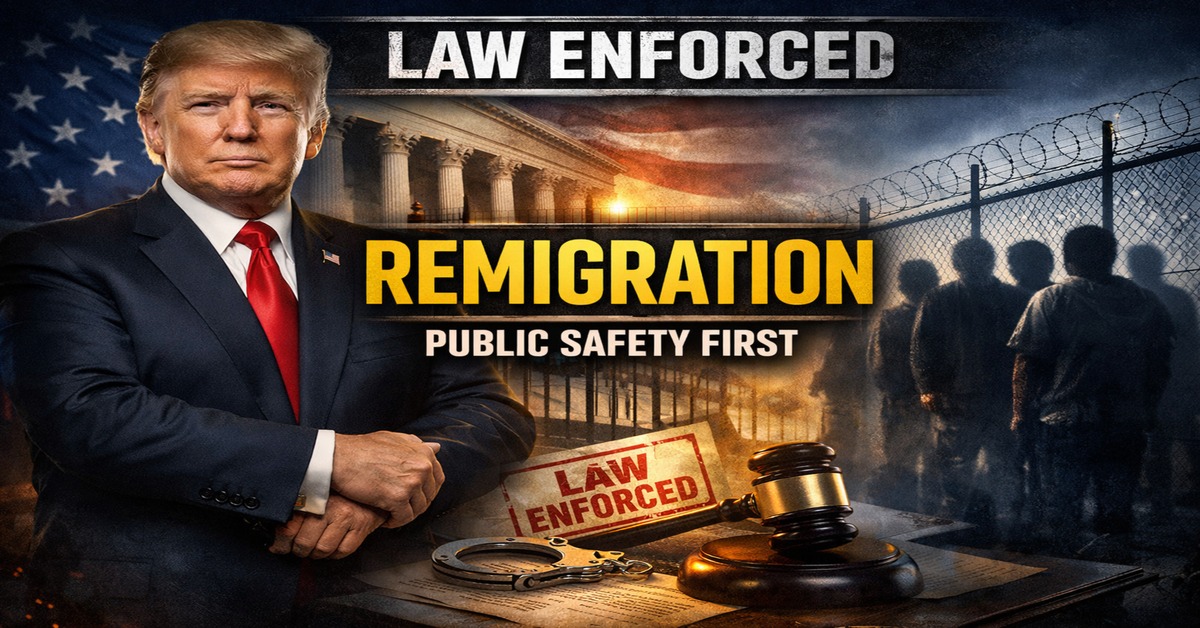
The term “remigration” has suddenly returned to public debate, and the response has been sharp. Some people hear it and recognize a problem that has been ignored for years. Others hear it and immediately brand it as reckless or extreme. That divide matters because refusing to discuss an issue does not prevent the damage that follows from neglect.
This argument is not abstract, and it is not a classroom exercise. Immigration enforcement comes down to a basic question. Does a country take ownership of its borders, or does it act as if those borders no longer exist? Decisions about safety, sovereignty, and responsibility all stem from that choice.
Entering the United States illegally breaks federal law. That reality is often softened or overlooked in public discussion. The pro-illegal aliens crowd will argue that entering the US illegally is a misdemeanor and only becomes a felony if they reenter illegally after being deported. They do this to make it seem to average Americans that sneaking into our country illegally is no big deal. Do you know what else are misdemeanors? Assault, domestic violence, and many other crimes are also misdemeanors and a big deal.
The stakes rise sharply when illegal presence is paired with violent crime. When someone who entered unlawfully commits rape, murder, or a serious assault, the harm cannot be undone. Families are shattered. Communities carry lasting trauma. These acts are not unavoidable events. They occur because the system failed before the crime took place.
A society cannot function if border enforcement is treated as optional while order is expected to hold on its own.
For decades, Americans were told that borders did not matter and assimilation was optional. We were assured that bringing in millions from failed societies would somehow strengthen this one. That promise was a lie. When people are allowed to enter a country with no expectation that they respect its laws, culture, or civic norms, the result is not diversity. It is disorder. Taxpayers pay more. Communities fracture. Crime rises. Social trust disappears.
VISIT OUR YOUTUBE CHANNELAnd notice who refuses to admit any of this. The Democratic Party. When the Trump administration removed violent criminal illegal aliens, Democrats did not applaud the enforcement of the law. They protested it. They behaved as if protecting Americans was the real offense. That told you everything you needed to know.
These are not people interested in fixing the damage. They are invested in pretending the damage does not exist. They will never support remigration because doing so would require acknowledging that their policies have harmed the country. So instead of accountability, they choose denial. Instead of solutions, they choose slogans. And Americans are left to live with the consequences.
Public Safety Is Not a “Hate Issue”
Supporting firm immigration enforcement is not rooted in hatred or prejudice. It comes from something far more basic. The understanding that laws exist for a reason, and when a government stops enforcing them, predictable harm follows. Societies that abandon their own rules do not become kinder. They become weaker and more dangerous.
Violent crime deserves the harshest lawful punishment, regardless of who commits it. But when those crimes are committed by non-citizens who should not be here in the first place, the response should be unmistakable. Prison first. Permanent removal afterward. This is not radical. It is how most functioning nations protect their people.
What is truly remarkable is how aggressively this reality is denied. The connection between mass illegal entry and preventable violence is treated as taboo. Citizens who speak up are accused of moral failure, while families who have lost loved ones are quietly ignored. That is not compassion. That is a refusal.
A government that prioritizes defending a narrative over defending its citizens forfeits its moral authority. And once that happens, trust collapses.
Free Speech and the Chilling of Truth
At the same time this debate is unfolding, something else is happening, and it deserves far more attention than it is getting. Open discussion about immigration and public safety is being steadily narrowed. Congressional hearings, sworn testimony, and released documents all point to an ongoing relationship between federal agencies and major technology companies over what is allowed to be said and what is quietly suppressed.
Lawyers can argue over the boundaries, but the effects are already obvious. When government officials lean on private platforms to limit certain viewpoints, public debate contracts. People can see it happening. One side is restricted. Another is amplified. Confidence erodes, and institutions that depend on trust begin to lose it.
A free society does not endure by managing speech behind closed doors. It survives when ideas are tested in public, especially the ones that make those in power uncomfortable. Once that stops, the problem is no longer about policy. It is about control.
America’s Role in a Fragile World
The consequences do not stop at domestic policy. The United States occupies a unique role in the world. Its economic power, military reach, and relatively stable institutions underpin much of the modern international order, whether people admit it or not.
When America weakens itself through internal disorder and collapsing public confidence, those effects do not stay contained. They spread. Power vacuums never remain open for long. History is clear on this point. When stability erodes, it attracts actors who are eager to exploit the weakness.
A strong America contributes to global stability. A country that cannot enforce its own laws, protect its citizens, or speak honestly about its failures loses the credibility required to lead. And once that credibility is gone, it does not return easily.
The Choice Ahead