





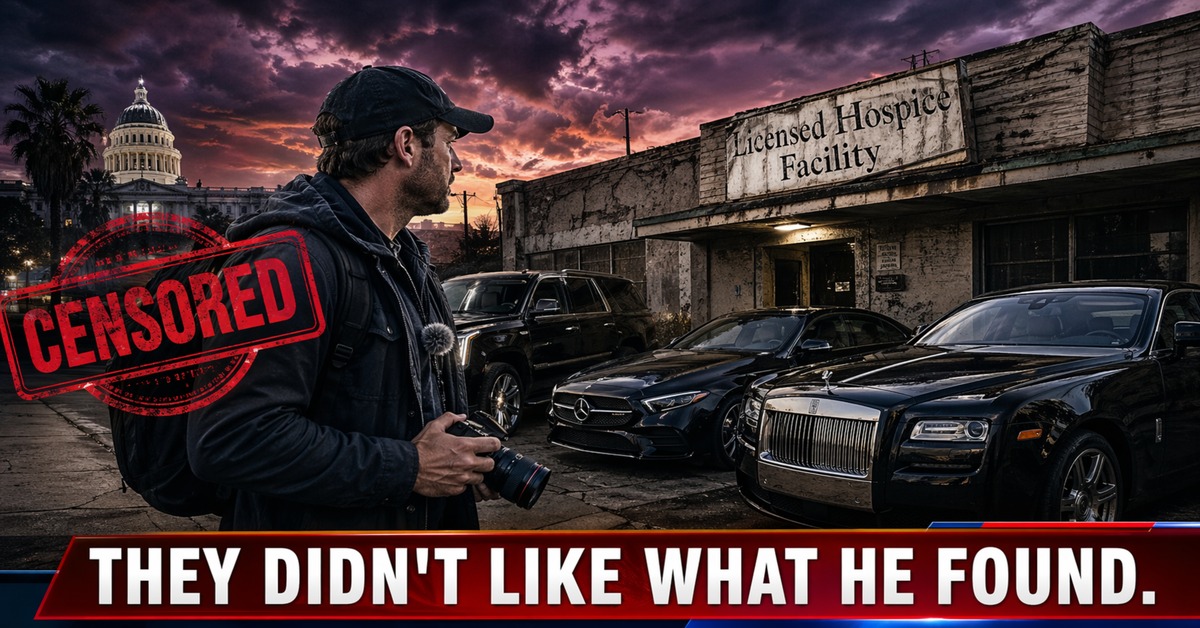
Let’s talk about what’s happening in California, because it deserves your full attention. A state that has become a symbol of government mismanagement and unchecked spending has now chosen a very specific strategy for handling its fraud problem. Rather than go after the fraud itself, officials are going after the people who find it. Washington state tried something similar not long ago, and only ran out of time before they could finish the job. California isn’t stopping short.
The bill has picked up a nickname that pretty much says everything: the “Stop Nick Shirley Bill.” Some people might hear that and think it’s being dramatic. Those people haven’t been following this story. Minnesota saw this. Washington state saw this. Now California. The tactics are identical, the talking points are identical, and the political party calling the shots is identical.
Who Exactly Is Nick Shirley, and Why Are Powerful People So Afraid of Him?
Nick Shirley does something that used to be considered basic journalism. He shows up. He goes to the actual address. He knocks on the actual door, turns on the camera, and shares what he finds with the public so they can draw their own conclusions. In California, he focused on hospice care fraud. He visited locations registered with the state as licensed hospice facilities and found crumbling buildings supposedly operating as home to dozens of providers, with luxury vehicles worth hundreds of thousands of dollars parked right out front. In Minnesota, he showed up at daycare centers that collected government funding but had not a single child, toy, or staff member visible anywhere on the property.
The moment Shirley’s California footage started circulating, Gavin Newsom’s office faced a choice any serious government would find obvious. They could have responded with something like, “This is serious. We’ll look into it.” Instead, they produced memes. One of them showed Shirley surrounded by cameras with the text, “Hey, can I see your kids?” The goal was to paint him as a predator rather than answer a single question about where the money was going. The San Francisco Chronicle contributed a fact-check claiming his reporting was exaggerated, pointing out that not all the hospices sharing an address were billing the state directly. This was printed while Shirley’s work was already producing criminal arrests.
Then federal agents appeared with search warrants, and the entire tone from Sacramento shifted in about 48 hours. Newsom got on X and announced that “California is again leading the charge against large-scale identity theft and hospice fraud,” taking credit for action against 14 providers who had billed Medi-Cal using stolen identities for hospice services that never existed. Reread that phrase. “California is again leading the charge.” A state that’s genuinely leading the charge against fraud doesn’t end up with fraud operating at an industrial scale inside its own borders. The state wasn’t leading anything. A guy with a camera and a willingness to knock on doors was.
Assembly Bill 2624: Taxpayer-Funded Witness Protection
AB 2624 carries the official title “Privacy for Immigration Support Services Providers Act.” What it actually does is build an address confidentiality program around designated immigrant support services providers and everyone who works with them. Organizations receiving public funding would receive protections that look remarkably like what the federal government offers to witnesses in organized crime cases. Publishing the protected addresses or identifying the people enrolled in this program would be treated as a criminal act.
VISIT OUR YOUTUBE CHANNELThe bill keeps going from there. It reaches into what ordinary people and journalists are allowed to post online about these facilities. The text says that “a person, business, or association shall not knowingly publicly post or publicly display, disclose, or distribute on the internet the personal information or image of any designated immigration support services provider, employee, or volunteer.”
Consider what that looks like when someone actually tries to do their job. A journalist standing outside one of these buildings with a camera could be committing a crime. A citizen walking up to the entrance and asking a question on video could be committing a crime. Beyond the criminal exposure, if anyone enrolled in the program decides to file a lawsuit, the bill hands them that ability directly. A journalist who fights back and wins in court could still spend hundreds of thousands of dollars in legal fees getting there. None of that is accidental. The entire architecture of the bill is designed to make the financial cost of investigation so painful that most people will quietly decide it isn’t worth the trouble.
The Woman Who Wrote This Bill Is Married to the State’s Top Law Enforcement Official
This is the section of the story where things go from infuriating to genuinely strange. The assemblywoman who introduced AB 2624 is Mia Bont. Her husband is Rob Bont, the Attorney General of California. The same Rob Bont who stood alongside Newsom ridiculing Nick Shirley’s journalism before smoothly repositioning himself as the man responsible for the resulting arrests.
Republican Assemblyman Carl DeMaio used a committee hearing to push Mia Bont on the specific scope of the bill’s language. He asked directly whether the prohibition on posting images of designated immigration support services providers would reach the fraud investigations Shirley had conducted. DeMaio referenced “the work site, those fake hospices that my colleague so diligently and effectively helped reveal in Los Angeles or the Learning Center that Mr. Shirley revealed in Minnesota,” and asked whether organizations like those would fall “under the definition of designated immigration support services provider.”
Her answer wandered considerably. She said, “I acknowledged just to clarify because you were mischaracterizing what I supposedly acknowledged. What I acknowledged was that under the scenario that you offered that individuals who were investigating were journalists. This bill has not… ensures that we protect lawful free speech and opportunity for criticism.”
She eventually landed on the suggestion that the bill simply wouldn’t touch “bona fide journalists.” That answer falls apart the moment you look at how California has actually treated Nick Shirley. Newsom’s team put him in a meme designed to make people think he was a child predator. Meanwhile, Washington state is spending public money on litigation specifically to argue that journalists, including this author and colleagues Jonathan Cho and Ari Hoffman, don’t qualify as legitimate press. If that’s the operating definition of “bona fide journalist” among these officials, Shirley never had a chance of qualifying. The bill was built around stopping people exactly like him.
The Part Where They Accidentally Describe ICE Agents
One more thing deserves to be said plainly. Democrats across blue states have spent months demanding that ICE agents remove their masks during enforcement operations. Washington state turned that demand into law. Their stated concern is that masked federal agents resemble an authoritarian force operating without accountability. Meanwhile, those same unmasked ICE agents are being doxxed. Home addresses. Family photos. Everything. People connected to those officers are in real danger.
When Assemblywoman Bont was asked about this directly, she justified her bill by explaining that it “ensures that we have an opportunity when people are being harassed… doxed… subjected to violence… to have the ability to be able to protect themselves.”
Read that one more time slowly. She described, with precision, the exact situation ICE agents are living in right now. The language fits perfectly. The concern, however, does not extend to them. The bill’s protections flow to taxpayer-funded organizations under active fraud investigation. Federal law enforcement officers whose personal information is being spread online by activists don’t receive any consideration at all.
That gap tells you exactly what the bill is for. It has nothing to do with shielding vulnerable people from harassment. It exists to put a wall around fraud that’s already been exposed, wear down the journalists willing to expose more of it, and send a clear message to anyone thinking about picking up a camera and following Nick Shirley’s example.
#nickshirley #californiafraud #ab2624


