


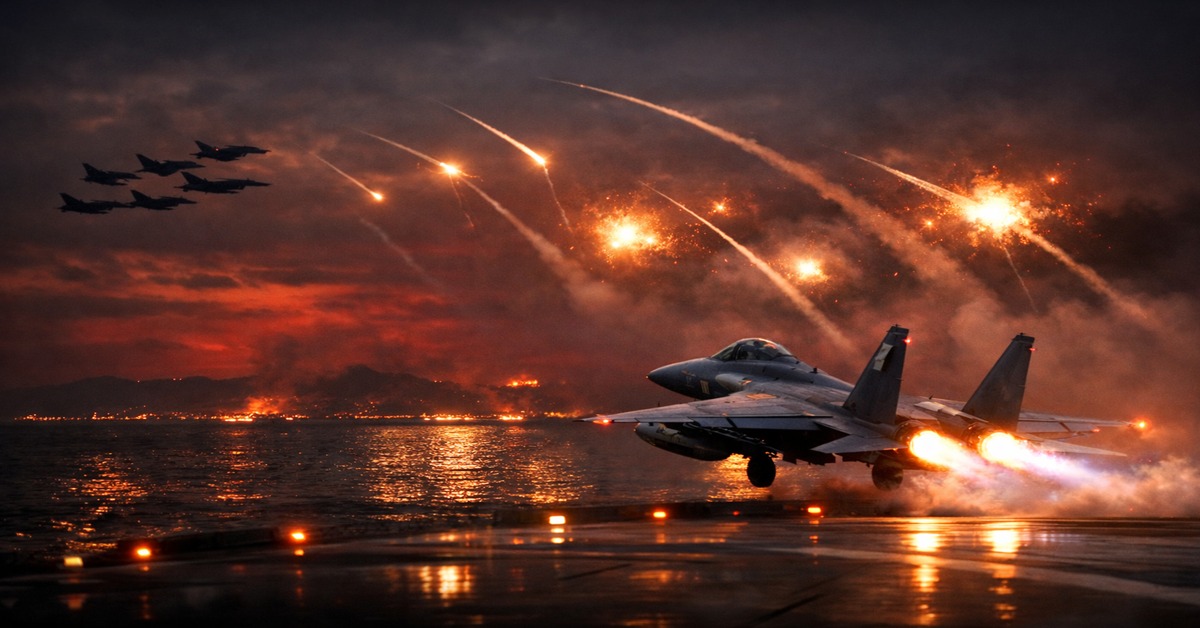
Not long ago, many foreign policy experts insisted that what just happened in the Middle East could never occur. Yet here we are. Qatar, one of the wealthiest nations on Earth and one of America’s most important military partners in the Persian Gulf, has reportedly carried out offensive strikes inside Iran. That fact alone is remarkable. Qatar spent years presenting itself as a diplomatic bridge between Iran and the West. The country tried to maintain communication with all sides in the region. Now the situation looks very different.
Qatar is not acting by itself. The United Arab Emirates, Saudi Arabia, Kuwait, and Bahrain are also mobilizing. What once looked like a diplomatic arrangement through the Abraham Accords is turning into something more serious. At first, the agreements seemed like standard diplomatic progress. Today, they appear to be forming the outline of a military partnership. If this development continues, the balance of power across the Middle East could shift in a major way.
Senior Western diplomatic officials say Qatar carried out strikes inside Iran within the past twenty-four hours. Israel’s Channel 12 first reported the development. Shortly afterward, a spokesperson from Qatar’s foreign ministry appeared to confirm the reports. These actions did not come out of nowhere. They followed a wave of attacks launched by Iran.
Since Saturday, Iran has fired three cruise missiles, 101 ballistic missiles, and 39 suicide drones toward Qatari territory. One target was Al Udeid Air Base. That installation is the largest American military base in the Middle East. The strike damaged a medical clinic located on the base. Iranian forces also attempted to hit an American early warning radar system.
Energy infrastructure became another target. Facilities in Mesaieed and Ras Laffan Industrial City were struck. Those locations are critical to Qatar’s energy production and economic stability. The attacks forced a halt in liquefied natural gas production. A drone also hit a power plant in an industrial zone in Doha.
Air defense systems intercepted many of the incoming threats. Even so, the damage continued. Debris from destroyed missiles fell into populated areas. Sixteen people were injured by falling shrapnel. At least one individual was reported to be in critical condition.
VISIT OUR YOUTUBE CHANNELThen the situation escalated further.
Iran attempted to strike Hamad International Airport, the primary civilian airport in Doha. The attack forced authorities to close the airspace. Nearly ten thousand passengers were suddenly stranded. Travelers had to be placed in hotels as the country temporarily suspended flights.
Qatari officials later confirmed that Iran provided no advance warning about these strikes. They also stated that Doha currently has no communication with Tehran.
That detail stands out when you remember Qatar’s previous relationship with Iran. For years, Qatar maintained open communication with the Iranian government. Al Jazeera, which operates from Qatar, frequently hosts voices sympathetic to Tehran. Qatar also allowed Hamas to maintain a political office in Doha. The country often tried to present itself as a diplomatic intermediary during regional disputes.
Now the atmosphere has shifted. Qatar appears to have been pushed into open conflict. The country has aligned itself with the United States and Israel. Not long ago that alignment would have sounded unlikely.
Reports indicate that Qatar carried out strikes inside Iranian territory. Officials confirmed that the operations occurred within the last twenty-four hours. Specific details about those strikes have not yet been publicly released.
There is also confirmation that Qatar’s air force shot down two Iranian Su-24 Fencer tactical bombers that were flying toward Qatari airspace. That action likely makes Qatar the first country to shoot down an Iranian aircraft during this conflict.
According to the Qatari Ministry of Defense, the Iranian aircraft received warnings before defensive action began. The jets were later shot down over the waters of the Arabian Gulf. During the same encounter, Qatar intercepted seven ballistic missiles and five drones.
The number of attacks Iran launched against Qatar is staggering. Since Saturday, the country has faced three cruise missiles, 101 ballistic missiles, and 39 suicide drones aimed at its territory.
The wider region is also under pressure. During the first thirty-six hours of escalation, Iran launched 165 missiles and 541 drones at the United Arab Emirates. Those strikes killed three people and wounded fifty-eight others.
Bahrain faced forty five missiles and nine drones. Kuwait was struck by 97 missiles and 283 drones. Jordan became the target of thirteen missiles and 36 drones.
Civilian infrastructure across the region has also suffered damage. Iranian drones struck the Fairmont Hotel in Dubai. Residential buildings in Bahrain were damaged. Kuwait International Airport was targeted. Dubai International Airport, the busiest international airport in the world, was struck by a drone and forced to suspend operations.
Even Oman became a target.
That development surprised many observers. Oman had been mediating nuclear negotiations involving Iran. Despite that role, Iranian forces still launched attacks against the country.
Iran’s foreign minister later suggested that Tehran may no longer have full control over its military operations. He stated that the Islamic Revolutionary Guard Corps carried out the strike on Oman and described the move as “not our choice.” He also acknowledged that Iran’s armed forces appear to be operating with a level of independence that suggests serious fractures within the command structure.
Diplomatically, that statement raises concerns for Tehran. Communication inside Iran’s military system may be breaking down.
In response to the growing crisis, the Gulf Cooperation Council held an emergency ministerial meeting. The council includes Saudi Arabia, the United Arab Emirates, Qatar, Bahrain, Kuwait, and Oman.
During that meeting, the nations invoked Article 51 of the United Nations Charter. That article recognizes the inherent right of self-defense. By invoking it, the Gulf states signaled their readiness to respond collectively if attacks continue.
The council also warned that additional strikes could transform the Gulf from a defensive zone into an active theater of military response.
There are already reports that Saudi Arabia is preparing potential strike options against Iran.
What we may be witnessing is the early stage of a new strategic alignment across the Middle East.
The Abraham Accords, negotiated during President Donald Trump’s first term, originally aimed to normalize diplomatic relations between Israel and several Arab nations. At the time, many observers treated the agreements as symbolic gestures.
Now those agreements appear to be revealing a deeper purpose.
The Accords created channels for intelligence sharing, military coordination, and security cooperation throughout the region. Israel, the United Arab Emirates, Bahrain, Morocco, Sudan, and other nations began building a network designed to counter the Iranian threat.
Today, that network appears to be developing into a military coalition.
For the first time in decades, Israel is fighting alongside several Arab states rather than remaining on the sidelines. The last time the region saw a coalition of comparable scale was during the Gulf War in 1991.
Iran’s strategy appears to have relied on intimidation. Tehran believed that heavy strikes against Gulf states would create panic. Iranian leaders expected those governments to pressure Washington to halt military action against Iran.
The strategy assumed that economic fear would fracture the alliance between the United States and Gulf monarchies.
Instead, the opposite occurred.
Iran’s attacks brought the region closer together.
One analyst at the Gulf International Forum explained the situation clearly. Iran crossed a dangerous line. The intention may have been to raise tensions in the Gulf to pressure the United States. Instead, the attacks pushed Sunni Arab states closer to Washington’s position in the conflict.
Another analyst observed that Iran transformed the Gulf states in a single day. Countries that once maintained cautious neutrality now see the threat from Tehran with far greater clarity.
Rather than intimidating neighboring nations, Iran strengthened the alliance forming against it.
This cooperation did not appear overnight. Intelligence sharing increased quietly over several years. Military coordination also expanded. A new CENTCOM Air and Missile Defense Coordination Cell opened at Al Udeid earlier this year to help coordinate regional defense systems.
Now those systems are becoming active.
The Gulf Cooperation Council is restoring joint air defense networks. Reconnaissance flights are increasing across regional airspace. Military coordination between these countries is expanding quickly.
Qatar has now entered the fight. Saudi Arabia appears ready to follow.
Together, these developments point toward the emergence of a new strategic order in the Middle East.
The Abraham Accords are no longer simply diplomatic agreements. They are becoming the foundation of a military coalition built around shared security interests.
The United States, Israel, and several Sunni Arab nations are aligning themselves against Iranian aggression.
By launching attacks across the Gulf region, Iran may have created the coalition it hoped to prevent.
Instead of weakening America’s position in the Middle East, Tehran may have helped form the strongest alliance the region has seen in modern history.
With the United States guiding the strategy, Israel providing military strength, and the Gulf states serving as the regional base, a new balance of power is beginning to take shape across the Middle East.
#middleeast #iran #abrahamaccords


