


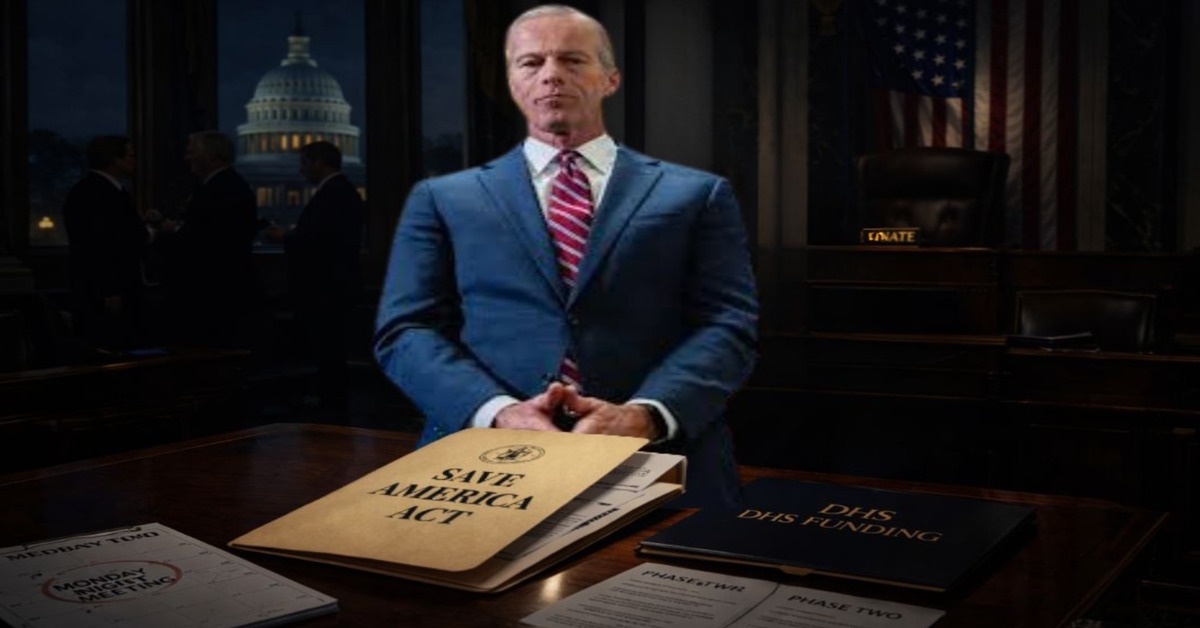
Something big just unfolded in Washington, D.C. It did not happen overnight. The pressure has been building for months. Now the situation has finally broken open. The Senate majority leader, who kept saying election integrity legislation could not realistically pass, has suddenly changed his position.
That man is Senator John Thune.
For months, many conservatives criticized Thune and accused him of blocking progress. Now he appears to have backed down. After weeks of hesitation, delays, and cautious statements, Thune is now allowing a path forward for the Save America Act.
Reports indicate that the turning point came after an important meeting at the White House on Monday evening. President Donald Trump met with several Republican senators to discuss strategy. Among those present were Senators Katie Britt, Steve Daines, and Lindsey Graham, along with newly confirmed Department of Homeland Security Secretary Markwayne Mullin.
Out of that meeting came a plan designed to push the Save America Act through the Senate while avoiding the Democrat filibuster barrier.
The proposal works in two stages.
VISIT OUR YOUTUBE CHANNELFirst, Republicans would pass a clean funding bill for the Department of Homeland Security to ensure the agency continues operating. After that bill passes, they would introduce a second reconciliation bill. That second bill would fund Immigration and Customs Enforcement enforcement efforts and include the Save America Act.
President Trump reportedly agreed that DHS funding and election legislation could move separately. He insisted on one requirement. The election provisions must follow immediately behind the funding bill using reconciliation.
Until recently, Senator Thune resisted this approach. He told reporters more than once that he did not believe a second reconciliation bill was necessary or appropriate. That changed after the White House meeting.
Speaking with Politico, Thune said a possible DHS funding agreement created new momentum for a reconciliation effort. He also told the Washington Examiner, “We’ll look at all the options on Save America, we’ve contemplated reconciliation for other things. We got a couple of vehicles available to us. And if we find that that’s a viable path that makes sense to get some things done, we will use it.”
Many conservatives see that statement as a clear shift. For months, Thune rejected reconciliation. Now he is openly discussing it as a workable option.
In simple terms, that looks like a retreat from his earlier position.
The Save America Act has become one of the most debated election integrity proposals in many years. Polling shows strong support among voters. Some surveys indicate that about seventy-one percent of likely voters support the legislation.
The bill would introduce two major changes. It would require documented proof of citizenship when registering to vote in federal elections. It would also require voters to show photo identification at the polls.
The House of Representatives has already approved the measure. The obstacle has always been the Senate.
For months, the legislation sat untouched because Democrats used an informal filibuster to prevent a vote. In the modern Senate, that tactic blocks almost any bill that cannot reach sixty votes.
This problem reflects a deeper issue inside the Senate itself. Over time, the filibuster evolved into a powerful tool for stopping legislation. Changes to Senate rules in the 1970s made the tactic easier to use. In today’s highly polarized political environment, reaching sixty votes has become extremely difficult.
The result has been legislative paralysis.
The Senate has not successfully passed major legislation through the traditional sixty-vote process since the Affordable Care Act in 2010. That means more than a decade of gridlock.
Republicans now face a choice. If they decide not to remove the filibuster entirely, they must find other ways to move legislation forward. Reconciliation offers one of the few options available.
Democrats used reconciliation several times in recent years.
The American Rescue Plan passed in 2021 using that process. The legislation involved about $1.9 trillion in spending and was passed with only Democratic votes.
The Inflation Reduction Act followed in 2022. That bill included roughly $800 billion in spending focused largely on energy programs and tax changes. It passed the Senate by a vote of 51 to 50 after Vice President Kamala Harris cast the deciding vote.
Republicans argue that if reconciliation was acceptable for those measures, it can also be used to address election integrity.
However, reconciliation comes with strict limits. One of the most important rules is called the Byrd Rule. It requires that provisions in reconciliation legislation must directly affect federal spending or federal revenue.
Some lawmakers remain uncertain about whether the Save America Act meets that requirement. Senator Mike Lee, who introduced the original bill, has suggested that passing it through reconciliation may be difficult.
Supporters of the new strategy believe the legislation can be structured to satisfy the rule.
Senator John Kennedy of Louisiana has been leading the effort to design that strategy. His argument focuses on the relationship between voter registration systems and federal benefit programs.
According to Kennedy’s reasoning, fraudulent voter registrations often rely on false identity documents. Those same documents can sometimes be used to obtain federal benefits. If voter rolls are cleaned up and identity verification improves, fraudulent benefit claims could decline.
Programs such as Medicaid, SNAP food assistance, Section 8 housing assistance, and Supplemental Security Income are limited to citizens and certain lawful immigrants. If someone uses a false identity to register to vote, that same identity could potentially appear in welfare systems.
If those fraudulent identities are removed, federal spending could decrease.
Another area involves unemployment insurance and Social Security programs. Workers who obtain employment through false documentation may attempt to claim unemployment benefits if they lose their jobs. Closing documentation loopholes could reduce those claims.
Supporters also point to a federal database called SAVE, which stands for Systematic Alien Verification for Entitlements. The Department of Homeland Security already uses this system to verify eligibility for federal benefits. The Save America Act would require states to compare voter rolls with this database.
Because the system already exists and has budget implications, expanding its use could qualify as a budget-related measure under reconciliation rules.
Even so, legal questions remain.
Senator Kennedy has suggested modifying parts of the legislation so its financial effects are clearer. The goal would be to allow the Congressional Budget Office to formally score the measure.
That would present the Save America Act not simply as election legislation but as a policy tied directly to federal spending programs.
In other words, the issue would involve both voting eligibility and government benefits.
Kennedy believes these revisions could be completed quickly. He has indicated the rewrite might take around ten days.
Public opinion polling also suggests strong support for election integrity policies. Surveys show that about eighty-three percent of likely voters believe ballots should arrive by Election Day. Another poll shows roughly eighty-four percent of independent voters support voter identification requirements.
Supporters say those numbers show the issue extends beyond traditional party divisions.
Now the focus turns to the Senate.
For months, the Save America Act seemed stuck in political limbo. Now the situation may be changing. If Republican leaders move forward with the reconciliation strategy, the bill could advance even without Democratic support.
The next few weeks will determine whether this moment becomes a real turning point or simply another episode in Washington’s long pattern of political stalemate.
#electionintegrity #saveamericaact #senatepolitics


