





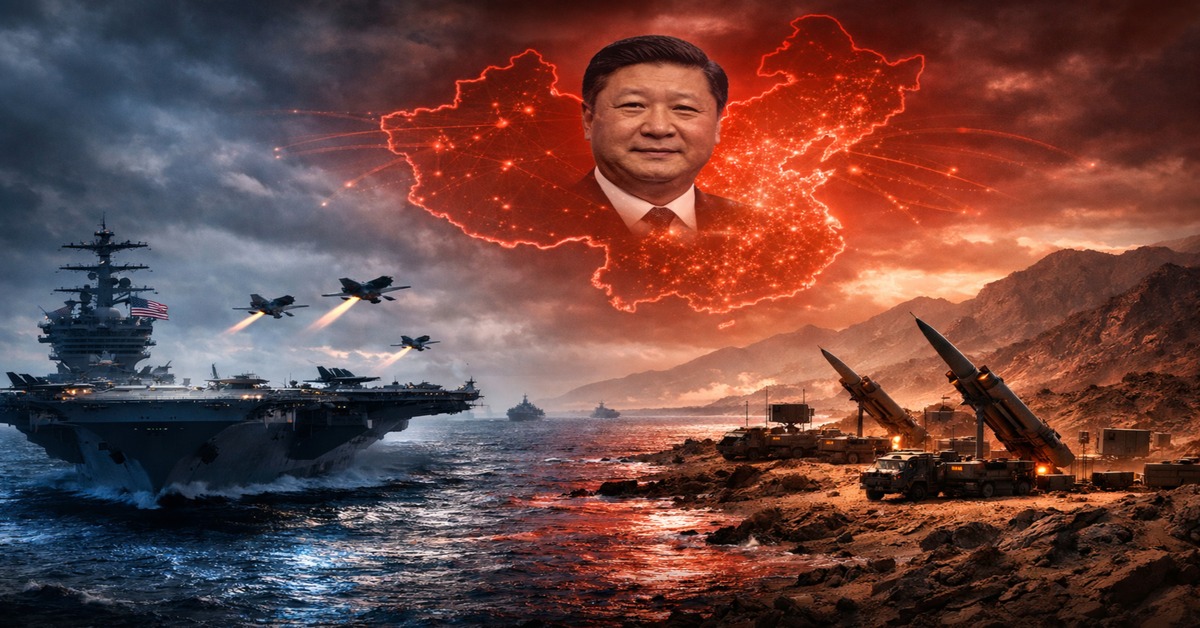
Think about a building that looks perfectly normal from the outside. The walls look solid. The structure seems stable. People walk in and out every day without concern. Then one day, the entire building collapses. Later, investigators discover the truth. The damage had been happening inside the walls for years. Weak supports, hidden cracks, and slow structural decay were quietly undermining everything. By the time anyone noticed, the collapse was already inevitable.
Something similar has been happening in global politics.
For years, the conversation about Iran has focused on nuclear weapons and terrorism. Those issues matter. Iran’s nuclear program has worried politicians for decades. Tehran’s support for terrorist organizations has shaped conflicts across the region. Yet focusing only on those problems hides something much bigger.
China sits behind the larger strategy.
Events unfolding around Iran right now could represent something unusual in modern geopolitics. The United States may be pushing back against a structure that quietly supports China’s long-term ambitions.
To understand why, you have to step back and look at the board the way Beijing sees it.
VISIT OUR YOUTUBE CHANNELMost people have been looking at Iran as the problem. They hear about nuclear programs, terrorist networks, and militant groups funded by Tehran. Those things are real. They have dominated headlines for years. But when you zoom out and look at the bigger strategic picture, something else comes into focus.
The situation unfolding around Iran may represent something we have not seen in decades. It may be the first American military effort that directly threatens a core part of China’s long-term global strategy.
That sounds dramatic, but the logic becomes clear once you start following the connections.
Iran Is Not Just a Rogue State
Iran is often described as a rogue regime. Analysts talk about nuclear proliferation, terrorist networks, and Iranian-backed militias operating in Lebanon, Syria, and Iraq. All of that is accurate. But those issues alone do not explain why Iran holds such strategic importance on the world stage.
So what actually makes Iran so important?
The answer is straightforward.
Iran functions as China’s anchor in the Middle East.
For years, Beijing has been building a deep partnership with Tehran. This was not a casual relationship. China poured enormous resources into economic agreements, infrastructure projects, and long-term strategic cooperation. The goal was to turn Iran into something more than a partner.
They wanted Iran to become a permanent pillar in China’s regional strategy.
Because of this, any serious effort by the United States to weaken Iran affects more than the Iranian government. It also disrupts the strategic framework China has spent years building in the region.
And the foundation of that framework starts with energy.
China’s Dependence on Iranian Oil
China purchases roughly 90 percent of Iran’s crude oil exports. That is an astonishing figure.
Pause for a moment and think about what that means.
China does not just buy some Iranian oil. It buys almost all of it.
The method used to move that oil is just as interesting. Much of the supply travels through what analysts call a “ghost fleet.” Tankers turn off their tracking transponders during transport. Shipments are relabeled to appear as Malaysian or Indonesian crude. These steps allow traders to avoid sanctions.
Since 2021, the value of China’s purchases of Iranian oil has exceeded 140 billion dollars.
This arrangement works perfectly for both governments.
China receives cheap energy to keep its factories running. Iran receives a massive buyer that keeps its economy alive.
The result is dependency. Iran becomes financially tied to Beijing. That matters because Iran sits near some of the most important energy routes on the planet. A country of about ninety million people is now economically connected to China in a very deep way.
Energy is just the first piece of the puzzle.
China Helped Build Iran’s Digital Control System
China has also played a major role in constructing the digital infrastructure that allows the Iranian regime to maintain control over its population.
Companies linked to the Chinese telecommunications sector have been heavily involved in Iran’s networks. Huawei and ZTE helped build large parts of the country’s communications system. These systems include surveillance cameras, facial recognition tools, and advanced internet monitoring.
One project stands out above the rest.
Iran created something called the National Information Network. It functions as a domestic version of the internet, isolating Iranian citizens from the global web.
If that sounds familiar, it should.
The system closely resembles China’s own Great Firewall.
When massive protests erupted across Iran earlier this year, the government responded by shutting down internet access across large areas of the country. The technology that allowed that shutdown relied heavily on Chinese infrastructure.
China not only supports Iran financially. It helped build the tools that allow the Iranian government to control its own population.
Iran’s Proxy Network and the Drain on American Power
Another part of Iran’s strategic value involves the network of proxy groups it supports.
Groups such as Hezbollah, the Houthis, and various militias operating throughout the Middle East are typically viewed as local security threats. But they also serve a broader geopolitical function.
They drain American resources.
The Red Sea crisis provides a clear example.
When Houthi forces began attacking commercial shipping routes, container traffic through the region collapsed. Global trade suffered immediate disruption. The United States responded by deploying naval forces and air defense systems to protect shipping lanes.
Stopping missile and drone attacks requires advanced interceptors. Each one can cost between $1 and $4 million.
Within months, the United States had reportedly used about a quarter of its high-end interceptor missile stockpile responding to these attacks.
Meanwhile, China stayed on the sidelines.
Chinese vessels moved through the region without interference. Chinese companies continued trading. Every dollar spent protecting shipping routes was a dollar that could not be spent preparing for a conflict in the Pacific.
China Expands Its Influence in the Gulf
Iran’s behavior has also reshaped relationships across the Middle East.
For decades, countries like Saudi Arabia, the United Arab Emirates, and Qatar relied heavily on the United States for security. That relationship has slowly become less certain in recent years.
China saw an opportunity.
Beijing expanded economic ties across the Gulf. China buys large volumes of Saudi oil. Chinese companies build ports and railways throughout the region. Telecommunications infrastructure linked to Huawei has spread across multiple countries.
Then something remarkable happened.
In 2023, China brokered a diplomatic agreement that restored relations between Saudi Arabia and Iran.
That moment signaled something new. China was no longer just an economic partner in the region. China had become a diplomatic power broker.
Each time Gulf governments broaden their partnerships away from Washington, China gains more influence.
The Taiwan Connection
Iran’s importance becomes even clearer when viewed through the lens of Taiwan.
China imports roughly seventy percent of its oil supply. That creates a serious vulnerability. Much of that oil moves through narrow sea routes such as the Strait of Malacca.
During a war over Taiwan, those routes could be blocked by the United States Navy.
That would create a major crisis for China.
To reduce that risk, Beijing needs alternative energy partners. Iran and Russia provide two options. China has also explored financial arrangements with Gulf states that could allow oil trading outside the U.S. dollar system.
If China maintains strong economic relationships across the Middle East, it gains energy security during a Taiwan conflict.
But if Iran collapses or becomes unstable, that entire strategy becomes far weaker. Are you starting to see the real picture of what’s going on now?
Why Recent U.S. Actions Matter
This broader context explains why recent American actions targeting Iran carry such large strategic implications.
Weakening Iran reduces the strength of its proxy network. Stabilizing the region frees American military power for another theater.
That theater is the Pacific.
The United States cannot fight large wars in multiple regions forever. Military resources are limited.
Every aircraft carrier stationed in the Persian Gulf is one that cannot operate in the Pacific. Every interceptor missile used against Iranian proxies cannot defend Taiwan.
From a strategic perspective, Iran has been a valuable piece on China’s geopolitical chessboard.
Removing that piece changes the entire game.
A Strategic Window Opens
Another development may have created a temporary opportunity.
Chinese leader Xi Jinping recently purged several senior military leaders. One of the most important figures removed was Zhang Youxia. He was one of the few commanders in the People’s Liberation Army with real combat experience.
Zhang had the authority and knowledge required to coordinate large military operations.
His removal left the Chinese command structure in a period of reorganization. Rebuilding a trusted leadership team inside the Central Military Commission will take time.
For now, China appears focused inward on controlling its own military hierarchy.
Ironically, this situation may make Taiwan temporarily safer.
Timing in Geopolitics
This situation creates a rare strategic moment.
If the United States and its allies ever intend to reshape the security landscape of the Middle East, this may be the moment to do it. The risk of China opening a second front over Taiwan appears lower now than it has in years.
Geopolitics often comes down to timing. Strategic opportunities open and close quickly.
Right now, the window appears open.
Which leads to a simple question.
If not now, when?
The Real Game Behind Iran
Iran may appear to be the main issue in the current conflict. In reality, it represents only one piece on a much larger board.
The deeper contest involves the global balance of power between the United States and China.
If Iran is removed from China’s strategic architecture, Beijing loses one of its most valuable geopolitical assets. If Iran remains firmly connected to China, the United States remains tied down in a regional struggle that benefits Beijing.
That is why what happens in Iran today may influence something much bigger.
It may shape the balance of power in the Pacific.
And it may help determine who holds the advantage when the Taiwan question finally reaches its decisive moment.
And if you think President Trump, Secretary of War Pete Hegseth, and the rest of the administration don’t understand all of this, I have some wonderful Iranian fortune cookies to sell you.
#geopolitics #china #iran



China will have to compete with India to make up for the loss of Venezuelan and Iranian oil. I reat that Trump was strengthening the dollar and punishing those who used BRICS.
There’s a third action of what could happen in Iran: the Iranian people could reestablish democratic pre-Ismamic government that won’t be too happy about China having propped up the previous government and aided it in repressing/controlling the people. Militaries are horrendously expensive to create and maintain and attacking Taiwan would cost more than China can afford in its current circumstances.