

Most people watching the conflict in Iran think the story is about the Middle East. They see missiles, oil tankers, and military operations in that region. That is the surface-level view.
Like I said recently, look closer, and another country appears in the picture. China.
The key move involves energy. China runs the largest manufacturing system in the world. That system needs oil every single day. The problem is simple. China does not produce enough oil at home. It must import huge amounts from other countries.
For years, China solved that problem by buying discounted oil from governments that were already under Western sanctions.
Two of those governments mattered more than the rest: Venezuela and Iran.
Donald Trump has now taken aim at both. Each of these rogue regimes has long posed a serious threat to its region and to global stability because of the governments that were in power.
VISIT OUR YOUTUBE CHANNELFirst came Venezuela. China had become the largest buyer of Venezuelan crude oil. Much of that oil moved quietly through complex shipping routes and financial arrangements. The shipments gave China a steady flow of cheap energy. In 2025, China imported roughly 389,000 barrels of Venezuelan crude per day, which was about 4% of its seaborne oil imports.
Trump moved against that system.
Sanctions increased. Oil shipments faced interception. The Venezuelan government itself came under direct pressure. The result weakened one of China’s most convenient sources of discounted oil.
That mattered because China relied heavily on oil from countries that Western markets avoided.
Then the second pressure point appeared: Iran.
China is the largest buyer of Iranian oil in the world, purchasing roughly 90% of Iran’s output. Iran sends the majority of its crude exports to China because many other countries avoid those shipments due to sanctions. Roughly 13% of China’s crude imports have come from Iran, making Beijing highly exposed to disruptions there.
When conflict with Iran escalates, or sanctions tighten, China feels it immediately.
Trump has already created economic pressure for China by exposing a fundamental weakness in its economic model. China’s growth has depended heavily on American consumers buying a large share of the crap its factories produce. Before the trade tariffs, roughly 20% of Chinese exports had historically gone to the United States. In Europe, that percentage is significantly lower.
The reality is simple. The United States has one of the largest consumer markets in the world. Millions of Americans have enough disposable income to buy electronics, clothing, tools, and countless other products manufactured in China. That purchasing power has helped fuel China’s manufacturing boom for decades.
When that demand is disrupted or reduced, it creates real strain on China’s economic system because a large portion of its industrial output was built around selling goods to American consumers.
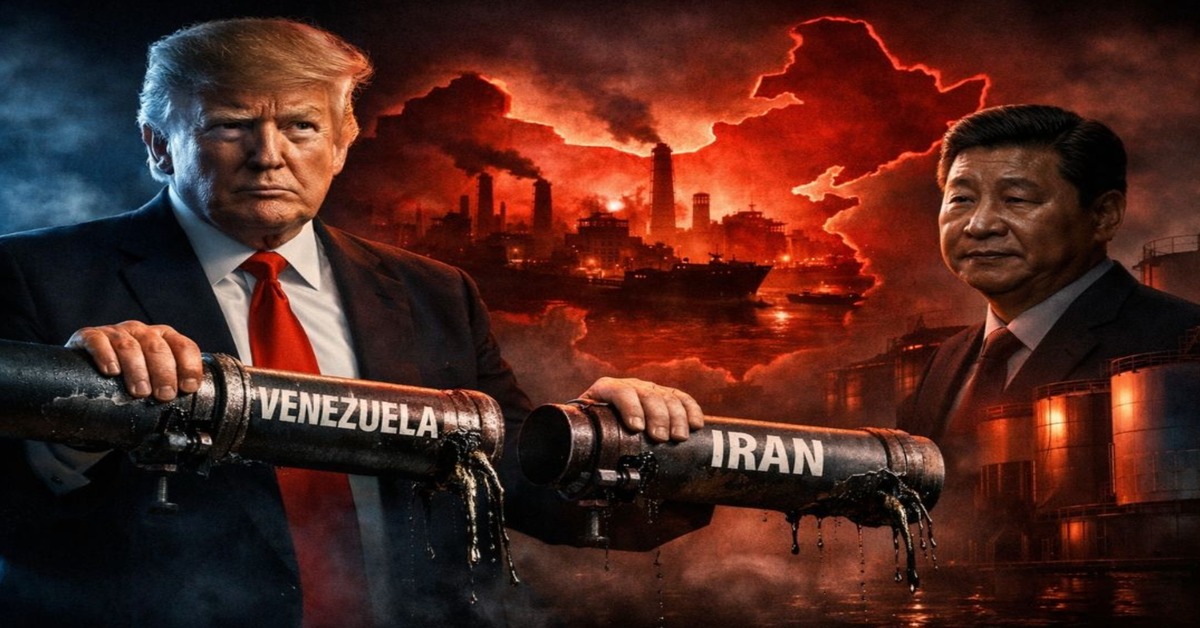
Trump’s strategy hits both ends of the same pipeline.
Venezuela in the Western Hemisphere.
Iran in the Middle East.
Each country had been selling discounted crude to Chinese refiners. Those barrels helped fuel Chinese industry while saving billions on import costs.
Remove those supplies, and the equation changes.
China still needs oil. Its factories still need power. Its transportation network still needs fuel.
But cheap sanctioned oil becomes harder to find.
Those suppliers often charge higher prices.
That raises costs inside China’s economy.
Trump’s strategy does not require a direct confrontation with China’s military. It works through pressure on the energy supply, and it’s brilliant.
Trump’s moves against Venezuela cut one pipeline.
Pressure on Iran threatens another.
Together, they target one of China’s biggest strategic vulnerabilities. Oil.
And when the world’s largest manufacturing economy faces uncertainty about its energy supply, the consequences reach far beyond the Middle East.
They reach straight into Beijing.
#trump #china #geopolitics