

The conflict between the United States and Iran is often explained in emotional or ideological terms. Many people say it is about religion, human rights, or moral responsibility. Others claim it revolves around Israel or the suffering of ordinary Iranians under a harsh government. Those explanations sound dramatic, but they miss the central point. At the center of this issue sits something much more practical and far more powerful. The driving force is money.
In global politics, the simplest rule is often the most accurate. If you want to understand why governments act the way they do, follow the money. Behind speeches, slogans, and official explanations, there is usually a contest for power, resources, and control of the economic system.
For decades, the United States occupied the top position in that system. The American dollar served as the main reserve currency for the world. Washington set the basic rules of global finance and trade. Other nations could criticize American policy, but they still had to function within a framework largely shaped by the United States.
Over time, however, that position began to shift.
During the Obama administration and later under President Biden, the United States gradually reduced its direct leadership role in several parts of the world. Critics argued that this shift allowed instability to spread. They believed that when a dominant power steps away from its responsibilities, other powers quickly move into the space that opens up.
This situation created what analysts often call a power vacuum.
VISIT OUR YOUTUBE CHANNELObama’s foreign policy approach was widely summarized with the phrase “leading from behind.” That description captures the basic idea. The United States allowed international developments to unfold with less direct intervention. Supporters described this strategy as thoughtful restraint. Opponents saw it as hesitation that allowed rivals to gain ground.
That development alone should have raised serious concerns.
During the same years, a separate geopolitical alignment began to emerge. China, Russia, and Iran increasingly operated in ways that suggested a loose strategic partnership. Each country contributed something different. China possessed enormous economic capacity and manufacturing power. Russia holds military strength and natural resources. Iran provided a strategic location and influence through allied groups across the Middle East.
Together, these three countries formed a partnership that challenged American influence.
China also expanded its reach through the Belt and Road Initiative. The Chinese government financed large infrastructure projects across Africa, South America, and parts of Asia. These projects included ports, rail systems, energy pipelines, and other transportation networks. This activity was not charity. It was part of a long-term strategy designed to expand Chinese influence and reduce American leverage over global trade routes.
Meanwhile, the United States was reducing its presence in the Middle East.
After many years of deep involvement, American leadership began stepping back from the region. Biden’s disastrous withdrawal from Afghanistan in 2021 became the clearest symbol of this shift. Governments around the world took notice. Many concluded that the United States no longer wanted to maintain the same level of control over strategic regions.
The consequences appeared quickly.
Iran began acting with greater confidence in the Persian Gulf. Countries in that region had long depended on American security protection. As American involvement declined, these nations started searching for new strategies. Some moved closer to Israel. Others attempted to improve relations with Iran. Every government in the region began adjusting to the new balance of power.
Russia also became more assertive. Its involvement in Syria and the invasion of Ukraine reflected a willingness to expand its influence. China continued to strengthen economic ties across the Middle East, Africa, and South America. These developments were not random events. They followed naturally from the absence of strong American leadership in key regions.
For the United States, this created a major strategic challenge.
No nation can remain the world’s leading power while its rivals gain control of energy corridors, trade networks, and key alliances. Once those systems begin shifting toward competitors, the balance of power starts to move with them. Under both Obama and Biden, the United States seemed comfortable allowing deeper dependence on foreign nations for critical supply chains. To many observers, it looked less like a strategy and more like the groundwork for weakening America’s long-term position.
Iran occupies an important place in this larger picture. Tehran has built influence through terrorist groups such as Hezbollah, Hamas, and the Houthis. These organizations extend Iranian influence across several areas of conflict in the Middle East.
The Houthis illustrate this influence clearly. Their attacks on shipping in the Red Sea disrupted one of the most critical commercial waterways in the world. At the same time, the Hamas attack against Israel on October 7 intensified regional tensions dramatically. These incidents are connected to a broader pattern of instability linked to Iran’s regional activities.
China enters the story for another reason.
China appears strong in many ways. It possesses vast manufacturing capacity, powerful supply chains, and one of the largest economies in the world. Yet it also has a major weakness. That weakness involves energy.
China depends heavily on imported oil. Approximately seventy percent of its oil supply comes from foreign sources. This creates a serious vulnerability. The Chinese industrial system relies on constant access to energy. Factories, transportation networks, and shipping operations all depend on steady oil deliveries. If those supplies become restricted or controlled by other powers, China faces a significant economic risk.
This reality leads directly to the importance of oil.
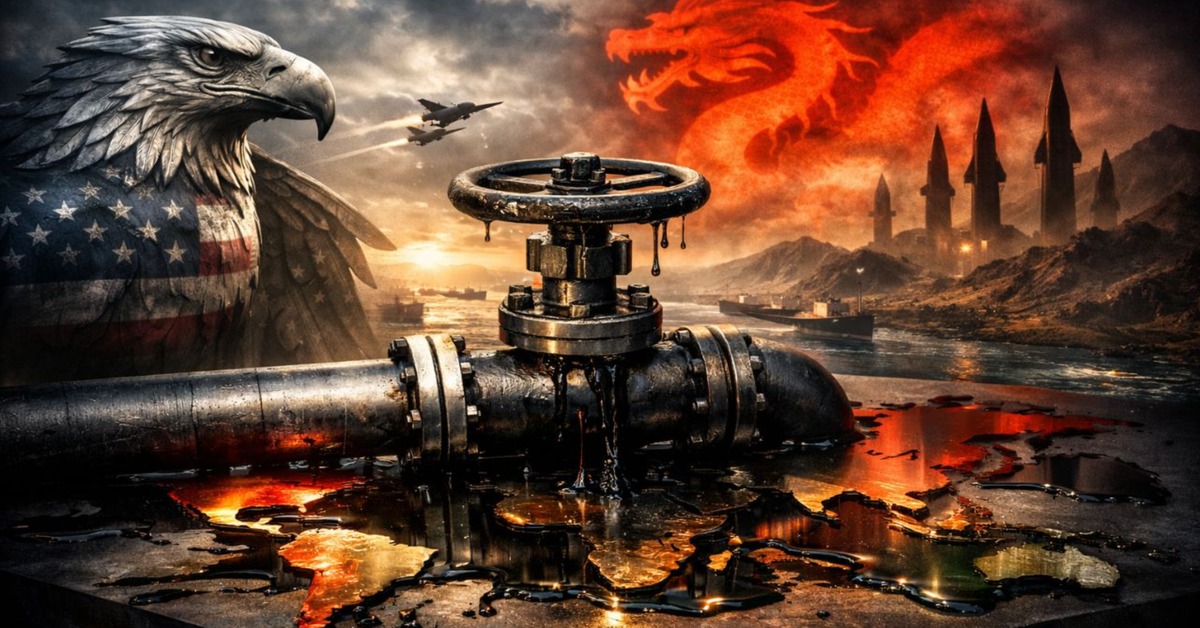
Iran and Venezuela possess some of the largest oil reserves on the planet. Combined, they control a huge share of global energy resources. Iran also borders the Strait of Hormuz, one of the most critical maritime choke points in the world. Roughly one-fifth of the global oil supply passes through that narrow waterway each day.
That location gives Iran extraordinary strategic importance.
Any government that influences oil production or transportation in that region gains major leverage in global markets. Control of those resources can affect prices, shape economic growth, and pressure governments across the world.
Israel plays a different role in this situation.
Israel is not primarily concerned with financial systems or global trade routes. Its concern is security. Iranian leaders have repeatedly expressed hostility toward Israel, and Iranian-supported groups operate near Israeli borders.
From Israel’s perspective, weakening Iran’s military power and limiting its proxy networks is a matter of national survival.
Because of this, the United States and Israel can approach the same conflict from different motivations. Their goals are not identical. Their interests still intersect when it comes to confronting Iranian influence.
When observers step back and look at the broader landscape, some analysts believe the confrontation with Iran forms part of a much larger effort to reshape global power. The logic behind this theory is straightforward. If Iran becomes weaker, the partnership connecting China, Russia, and Iran becomes less stable. Once that triangle begins to break apart, the geopolitical map can shift.
Evidence of this possible shift appears in plans for a new economic corridor linking India, the Gulf states, Israel, and Europe. Such a route could provide an alternative to trade systems influenced heavily by China. It could also strengthen cooperation among several countries aligned with the United States.
The importance of these developments lies in a simple fact. Global influence continues to revolve around three essential factors. Energy resources remain crucial. Trade routes determine how goods move across continents. Financial systems define how nations conduct business.
Countries compete constantly to control those systems.
When governments struggle for influence over those areas, tensions often follow. Sometimes the conflict takes the form of negotiations or economic sanctions. In other situations, it becomes a military confrontation. The methods change depending on circumstances. The underlying competition remains the same.
In the end, after speeches, propaganda, and endless commentary, the fundamental principle does not change.
Control the resources.
Control the trade routes.
Control the money.
And you control the balance of power.
#geopolitics #energysecurity #globalpower