





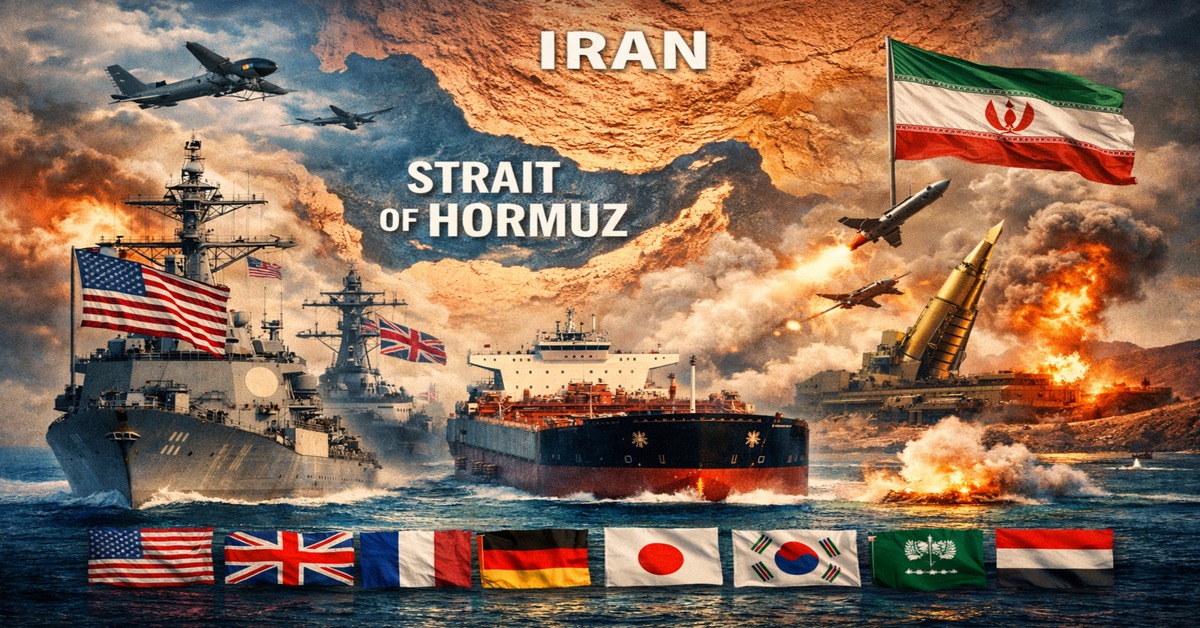
Let’s walk through a story that is becoming increasingly important, even if it has not yet dominated every headline. It centers on the Strait of Hormuz. This narrow waterway sits at the heart of global energy transport. An enormous share of the world’s oil supply moves through it. Any disruption there can ripple through markets and economies across the globe.
At the center of the current concern is Iran.
More than twenty countries stretching from Europe to Asia to the Gulf have begun signaling that they may take part in protecting that shipping corridor. In their most recent statement, those nations indicated a “readiness to contribute” to efforts that would keep commercial vessels moving safely through the Strait despite ongoing threats from the Islamist government in Tehran.
That kind of language matters. When a coalition this large begins coordinating around maritime security, it usually means officials believe the threat is serious.
The announcement came in the form of a joint statement released on Saturday morning. It listed the participating nations. Those countries include Australia, Bahrain, Canada, Czechia, Denmark, Estonia, Finland, France, Germany, Italy, Japan, Latvia, Lithuania, the Netherlands, New Zealand, Norway, the Republic of Korea, Romania, Slovenia, Sweden, the United Arab Emirates, and the United Kingdom.
Those governments issued a clear condemnation of Iran’s recent activity. Their statement focused on attacks against civilian shipping as well as strikes targeting oil and gas infrastructure throughout the Gulf region. They also criticized Iran’s attempts to disrupt vessel traffic through the Strait of Hormuz.
VISIT OUR YOUTUBE CHANNELThe coalition did not soften its language.
“We express our deep concern about the escalating conflict. We call on Iran to cease immediately its threats, laying of mines, drone and missile attacks, and other attempts to block the Strait to commercial shipping, and to comply with UN Security Council Resolution 2817,” the group of nations said.
The statement continued by highlighting why the issue reaches far beyond the Middle East.
“Freedom of navigation is a fundamental principle of international law, including under the United Nations Convention on the Law of the Sea. The effects of Iran’s actions will be felt by people in all parts of the world, especially the most vulnerable.”
That warning captures the core reality. The Strait of Hormuz works like a release valve for the global energy market. When tankers pass through without interruption, prices remain relatively steady. When instability enters the picture, markets react quickly and sometimes violently.
The coalition also stressed that attacks on shipping lanes and energy infrastructure threaten international stability.
“We emphasise that such interference with international shipping and the disruption of global energy supply chains constitute a threat to international peace and security. In this regard, we call for an immediate comprehensive moratorium on attacks on civilian infrastructure, including oil and gas installations,” they continued.
Then came the line that revealed the practical implications of the statement.
“We express our readiness to contribute to appropriate efforts to ensure safe passage through the Strait. We welcome the commitment of nations who are engaging in preparatory planning.”
That language signals something important. Governments are moving beyond diplomacy and beginning to consider operational planning.
All of this unfolds against the backdrop of recent military action that has already damaged Iran’s naval capabilities. The United States and Israel have carried out strikes that eliminated a large portion of Iran’s maritime assets. That includes dozens of vessels designed for laying sea mines.
Even so, shipping companies remain cautious. Many commercial vessels still avoid the Strait. Iranian forces can launch attacks from positions along the coastline. There is also concern that mines could already be sitting in the water, placed earlier by Iranian forces or proxy groups.
U.S. Central Command has been closely involved in dealing with those threats. Admiral Brad Cooper, who leads CENTCOM, addressed the situation on Saturday.
He said Iran’s ability to threaten ships in the Strait has been “degraded.” He also explained that U.S. operations continue with the goal of reducing Iran’s ability to project military power beyond its borders.
Cooper described recent attacks against missile infrastructure located along Iran’s coastline.
According to the admiral, American forces used several 5,000-pound bunker-busting bombs against underground facilities that stored missile systems and launch equipment. These sites posed a direct risk to commercial shipping routes.
He summarized the outcome in clear terms.
“We not only took out the facility but also destroyed intelligence support sites and missile radar relays that were used to monitor ship movements,” he said. “Iran’s ability to threaten freedom of navigation in and around the Strait of Hormuz is degraded as a result and we will not stop pursuing these targets.”
While military activity continues, the political conversation has also intensified.
On Friday, President Trump addressed the issue directly. He pointed out that many allied countries depend heavily on the oil that passes through the Strait of Hormuz. The United States now produces much of its own energy.
Trump suggested those allies should participate in protecting the waterway.
President Trump said that “it would be nice” for allied nations that depend on oil shipments moving through the Strait of Hormuz to help keep the passage open, pointing out that the United States is largely energy independent and therefore less vulnerable to disruptions if the waterway were closed.
He also argued that the operation itself would not be overly complex from a military standpoint.
President Trump said that it would be a relatively “simple military maneuver,” but said that a large “volume” of ships would be required for the effort.
That final point explains the scale of the challenge. Keeping a shipping lane secure requires continuous presence. Naval patrols must operate alongside escort vessels. Surveillance aircraft must monitor activity. Specialized teams must search for mines. All of that must work together around the clock.
The reason for this effort is straightforward.
The Strait of Hormuz stands as one of the most critical choke points in the global energy system.
Roughly one-fifth of the planet’s oil and natural gas shipments move through that narrow corridor.
If traffic continues normally, markets remain stable. If the channel closes, prices surge. Supply chains tighten. Economies across the world begin to feel the pressure.
That is why so many governments are now signaling their willingness to get involved.
They understand that events unfolding in that narrow stretch of water will affect far more than the ships passing through it.
#straitofhormuz #iranthreat #globalsecurity


