

Let’s talk about something happening at the Supreme Court that could have major consequences for immigration policy in the United States.
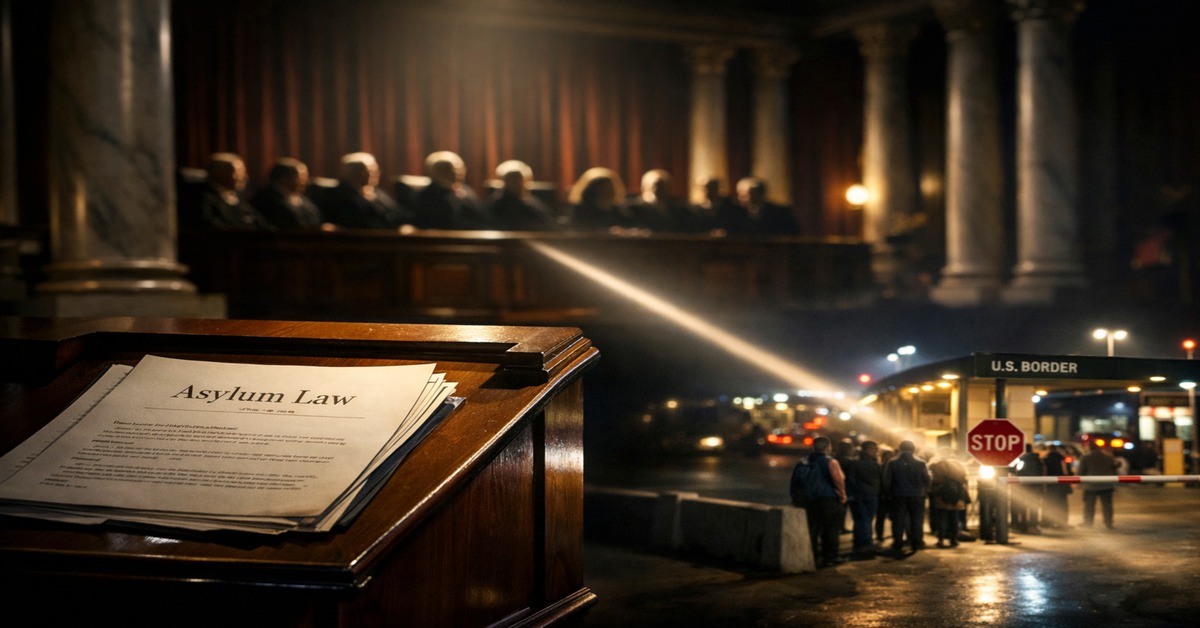
The justices recently heard arguments in a case called Noem v. Al Otro Lado, and the discussion focused on a policy from the Trump administration known as “metering.” The basic idea behind this policy is simple. Migrants waiting in Mexico cannot immediately make asylum claims if they have not been processed through a U.S. port of entry. Instead, the government controls the flow of people who are allowed to approach and request asylum.
Supporters of the policy say it helps manage overwhelming traffic at the border. Critics argue it violates U.S. immigration law.
That is where the legal fight begins.
The law at the center of this case goes back to 1990. Congress passed the Immigration and Nationality Act, which states that anyone who “arrives in the United States” has the right to apply for asylum and must be inspected by an immigration officer.
That sounds straightforward. The problem is that the law never clearly defines what it means to “arrive.”
VISIT OUR YOUTUBE CHANNELSo the justices spent a lot of time wrestling with that exact question.
Justice Amy Coney Barrett pushed directly on the issue. She wanted to know how the Court should determine the exact moment someone has officially entered the United States.
“What is the magic thing that we’re saying happens to make it so now someone arrives in the United States?” Barrett asked.
That question gets to the heart of the dispute.
Kelsi Cockran, a lawyer representing the advocacy group Al Otro Lado, argued that a person arrives once they reach the immediate entrance of a port of entry and are about to step across.
In other words, she suggested the key moment happens when someone stands right at the gateway.
Justice Brett Kavanaugh did not seem convinced. To him, the idea sounded too vague and too easy to manipulate.
“It seems very artificial trying to figure out, ‘at the threshold,’” Kavanaugh said. “Threshold means government will stop you short of the threshold.”
Other justices tried to test the concept with everyday examples.
Chief Justice John Roberts offered a comparison that almost anyone can understand. Think about standing in line at a concert.
“If you’re at the end of a long line, you’re not there, you haven’t arrived at the turnstile,” Roberts said.
His point was clear. Waiting nearby does not necessarily mean you have arrived at the place where entry actually happens.
At the same time, some justices raised a different concern about how the policy might affect behavior at the border.
Justices Sonia Sotomayor and Ketanji Brown Jackson suggested that restricting asylum claims at official crossings could push migrants toward illegal entry instead.
Jackson pressed the issue directly and pointed out the possible contradiction.
“Why would his asylum request be discarded, but someone who manages to enter the United States illegally and requests asylum gets their application entertained?” Jackson said.
That question highlights a tension in immigration policy. Should the system reward people who cross the border illegally while discouraging those who wait at legal entry points?
Vivek Suri, representing the Trump administration, defended the metering policy. He argued that it exists for practical reasons. Border crossings have limits. Ports of entry can only process so many people at a time.
“Metering is not saying you can never enter the U.S. and the only option is to enter illegally,” Suri said. “The U.S. has greater responsibilities to those in the U.S. than those in Mexico.”
At the moment, the policy is not actively being used because access at the border has already been restricted in other ways. That led Jackson and Sotomayor to suggest that the policy might no longer be necessary.
Suri pushed back on that idea.
He explained that the government wants to keep the option available if the border situation changes in the future.
“This is a tool that [The Department of Homeland Security] would want in its toolbox,” Suri said. “This is an important tool that the government would want in its toolbox.”
The reasoning is simple. Border infrastructure has limits. Sometimes officials need to slow things down.
“[It’s] necessary for ports to say ‘sorry, we’re at capacity, try again next time,’” Suri said.
For now, the justices are weighing the arguments and reviewing the law. A decision is expected before the Court’s term ends in June. When that ruling arrives, it could clarify one of the most basic questions in immigration law.