


What we may be watching right now is not just another rough week for Democrats. Some conservatives believe the recent Virginia Supreme Court ruling represents something much bigger. In their view, it could become the start of a political realignment that reshapes congressional power for years to come.
The argument is that Democrats watched years of political planning begin collapsing in only a few days. Court rulings, redistricting battles, and changing population patterns are all being cited as forces that may increasingly favor Republicans over the long term. At the center of the controversy is the Virginia Supreme Court’s 4-3 decision striking down an April 21 referendum that would have redrawn Virginia’s congressional districts into a map critics described as heavily tilted toward Democrats. It would have taken the fairest map in the land to the most biased and ridiculous map in the country. It would have gone from 6 Democrats to 5 Republicans, over to 10 Democrats and one Republican.
According to the ruling, the referendum violated Virginia’s constitutional amendment process. Under the Virginia Constitution, amendments to the state Constitution must pass through two separate General Assemblies before voters are even allowed to weigh in. In plain English, the legislature votes once, then a new legislature must be elected and vote on the exact same measure a second time. Only after passing both assemblies does the proposal go before the people of Virginia for final approval.
Critics argue that the Virginia Assembly, along with Governor Spanberger, chose to bypass that second legislative vote entirely. Instead of waiting for another election cycle and another assembly session, they attempted to fast-track the referendum directly to voters, a move opponents say was designed to avoid delays and lock in an advantage against Republicans.
So, the Democrats attempted to bypass that requirement by forcing the referendum through during a single legislative session. The court ultimately ruled the effort unconstitutional. The lower court judge ruled multiple times that the measure was unconstitutional, but Virginia lawmakers kept going forward.
Conservatives are describing the decision as a major setback for Democrats’ hopes of reclaiming the House of Representatives. Election projections now suggest Republicans could hold as many as 217 “safe to leaning” seats following the ruling. That would leave the GOP needing only one toss-up district to keep control of the House. Even during the Democrats’ strong 2018 midterm performance, they still failed to win every toss-up race.
VISIT OUR YOUTUBE CHANNELAdditional redistricting battles in states such as Louisiana, Mississippi, Tennessee, and South Carolina are also expected to strengthen Republican advantages heading into the 2026 elections. Some analysts believe Republicans may enter the midterms with a built-in advantage before voters even cast ballots.
One of the most explosive claims surrounding the controversy involves reports that some Democrats are considering a plan to remove the entire Virginia Supreme Court from office. The proposal would allegedly lower the mandatory retirement age for judges from 73 to 54, instantly forcing every current justice off the bench. The Democrats want to do this to replace them with radical progressive judges willing to overturn the redistricting ruling. In other words, cheat… again!
Opponents are calling the proposal a “gut and pack” strategy. They compare it to aggressive judicial manipulation tactics often seen in politically unstable systems. In their view, the idea reflects growing panic among Democratic leadership as demographic changes and legal rulings continue shifting momentum toward Republicans.
Right now, it seems that the Democrats are willing to go to any length to hold on to power. Voters should recognize that in the next election.
The timeline itself may make such a plan impossible. Virginia Department of Elections Commissioner Steven Kofsky reportedly warned the court that May 12 represented the “point of no return” for implementing congressional district maps. After that date, election systems, voter assignments, and ballot programming would already be too far along to safely reverse without creating widespread confusion and administrative problems.
Because of that deadline, critics argue there is no realistic path for Democrats to rewrite the law, remove the court, appoint new justices, reverse the ruling, and impose a new congressional map before election preparations become locked in place. Even if such an effort were attempted, legal experts believe it would immediately face constitutional challenges in court.
The broader argument goes beyond Virginia. Recent Supreme Court rulings against race-based gerrymandering are now being viewed as a threat to a political structure Democrats relied on for decades. For decades, the Democratic Party has gerrymandered by race all across the country, stealing seats from Republicans by splitting up congressional districts by connecting black neighborhoods that could be 200 miles apart as a single district. The case of Louisiana v. Callais just struck down the racist gerrymandering, and Democrats are set to lose up to 18 House seats practically overnight.
This is how the House race looks as of right now:
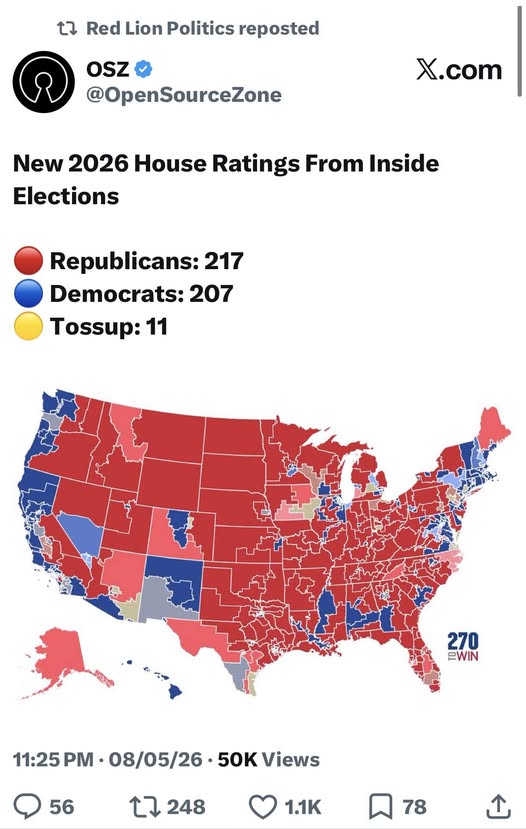
There are 11 toss-up races for House seats. The Republicans are right now at 217. They only need to win 1 of the 11 toss-up races to keep the House majority.
When you combine that with the fact that we are now seeing the Great Escape of American families and companies moving out of blue states and heading for the freedom of red states, the Democrats will get hit really hard by the next census. Red states like Florida, Ohio, Tennessee, and Texas are getting the benefit of frustrated Americans from blue states moving in. They bring their money, businesses, and, more importantly, their votes.
Many believe we are witnessing the beginning of the Democrats having to come to grips with losing all influence in Congress for a very long time. And they have no one but themselves to blame. When you treat your constituents like dogs, the dogs can get up and leave.
Many on the right see this as far more than just another rough election cycle for Democrats. In their view, the ground underneath American politics is starting to move. They believe the combination of court rulings, redistricting battles, and population shifts is slowly reshaping the electoral map in ways that could lock Democrats out of power for an entire generation.
#virginia #redistricting #midterms