


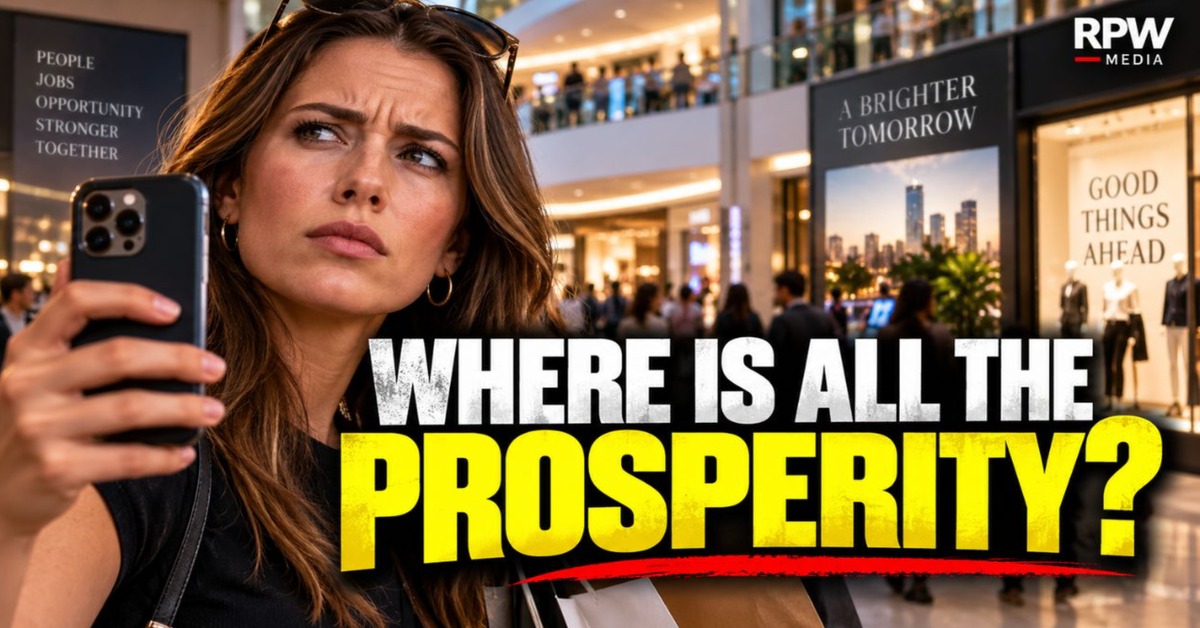
There is a strange contradiction taking hold in America. We are surrounded by comforts, opportunities, and technology that previous generations could barely have imagined. Yet, a growing number of Americans have become convinced that prosperity has somehow passed them by.
Do you know why the Amish don’t feel this way? Because they don’t have television.
You can see the contradiction almost anywhere.
Walk through an ordinary American neighborhood and look at what we now consider normal. Packages arrive at our homes containing products manufactured thousands of miles away, ordered yesterday. A college student can carry access to more information in her pocket than entire libraries once contained. Families can video chat with relatives on the other side of the country for practically nothing. Grocery stores offer food from around the world every day of the year.
None of this feels extraordinary anymore.
That may actually be part of the problem.
VISIT OUR YOUTUBE CHANNELWhen something becomes a normal part of everyday life, we stop noticing how remarkable it is. Indoor plumbing doesn’t impress us. Electricity is expected. Air conditioning is something we complain about when it isn’t cold enough. We become irritated when a webpage takes several seconds to load.
I was on a flight from Philadelphia to Atlanta when the Wi-Fi suddenly went out. Almost immediately, people who had been using it started getting irritated and complaining to anyone who would listen.
I remember sitting there thinking about how absurd the whole thing was. Here we were, 30,000 feet above the ground, sitting comfortably inside a metal tube hurtling through the sky at roughly 500 miles per hour, and people were angry because they couldn’t get on the internet.
Think about that for a second. Human beings spent thousands of years dreaming about being able to fly. Now we can sit in a chair, travel hundreds of miles through the air in a couple of hours, and barely give it a second thought.
The incredible had become so ordinary that losing Wi-Fi for a little while felt more remarkable than flying through the sky at nearly 500 miles per hour.
That is what prosperity looks like when people have lived with it their entire lives.
This is particularly noticeable among younger Americans. Socialist ideas have become increasingly attractive to a generation that has grown up hearing that capitalism has failed them.
Congresswoman Alexandria Ocasio-Cortez (D-NY) once described the millennial experience this way in Newsweek: “An entire generation, which is now becoming one of the largest electorates in America, came of age and never saw American prosperity. I have never seen that, or experienced it, really, in my adult life.”
Think about what that statement actually suggests.
A generation surrounded by smartphones, commercial air travel, modern medicine, streaming entertainment, online education, instant communication, enormous supermarkets, and countless consumer choices is being told it has never witnessed American prosperity.
Maybe the real issue isn’t that prosperity disappeared.
Maybe prosperity became so ordinary that we stopped recognizing it.
Imagine someone who has lived beside the ocean since birth. The person who travels hundreds of miles to see it for the first time may stand there amazed. The lifelong resident might barely glance at it while driving to work. The ocean didn’t become less impressive. Familiarity simply changed the way it was perceived.
Something similar has happened with American prosperity.
Most younger Americans have never experienced a society without modern conveniences. We don’t remember a world where communicating with somebody across the country required paying for a long-distance telephone call. We never had to navigate a strange city using a folded paper map. We don’t know what it is like to wait weeks for information that can now be found in seconds.
Technology that would have seemed miraculous a few generations ago is now so commonplace that people become angry when their Wi-Fi slows down.
Consider another hypothetical example. Give someone a car after that person has spent years walking several miles to work every morning, and that car represents freedom. Give someone a car at sixteen and surround that person with automobiles from birth, and eventually a working car can feel like nothing more than the minimum they were supposed to receive. Now compare that to someone who didn’t get their first car until their mid-20s because they had to save up to buy it themself.
The difference isn’t necessarily the possession itself. The difference is perspective.
That perspective becomes even more important when America is compared with places where genuine deprivation remains part of everyday life. There are still people around the world struggling for reliable food, clean water, safe housing, basic medical treatment, or the political freedom to openly criticize their government.
Meanwhile, people from around the world are still desperately trying to come to the United States. And I’m not talking about the millions of illegal immigrants who crossed the border during the Biden years. I’m talking about the hundreds of thousands of people who want to come here legally, become Americans, build lives for themselves and their families, and add something of value to the great American melting pot.
That should tell us something.
None of this means America has no problems. Prosperity does not eliminate hardship. Americans struggle with debt, housing costs, medical bills, unemployment, family problems, and countless other difficulties. Capitalism is not a magical system that guarantees every person an easy life.
But acknowledging problems is very different from pretending prosperity doesn’t exist.
There is also an important historical difference between today’s younger generations and those that came before them.
Americans who lived through the Great Depression (my parents) knew what economic collapse looked like. Families who endured World War II (my grandparents) understood rationing and sacrifice. Other generations experienced Korea (my father) and Vietnam or watched communist governments promise equality while producing repression and economic misery for all.
Younger Americans inherited a very different starting point.
For many of us, cars were already everywhere. Television was ordinary. Supermarkets were full. Computers became commonplace. The internet arrived, followed by smartphones, social media, streaming video, online shopping, GPS navigation, and practically instant access to information.
These things have led to the concept of “instant gratification,” which is the culprit behind our dissatisfaction when one of our modern marvels stops working for even a minute.
There was no dramatic moment when most of us went from scarcity to abundance.
We were born into abundance.
That makes prosperity surprisingly difficult to recognize.
It also helps explain why political promises to completely restructure the economic system can sound attractive. If someone believes today’s standard of living represents economic failure, tearing apart the system that helped produce it may not seem particularly risky.
We got a remarkable reminder of this during the 2026 World Cup. Thousands of foreign fans came to the United States, many of them from Europe, and something unexpected started happening on social media. They began posting videos marveling at things Americans barely notice anymore. They wandered through enormous supermarkets, amazed by the selection. They couldn’t believe the size of our stores, the free drink refills, the air conditioning, the restaurants, the highways, and even places like Buc-ee’s. Some were just as surprised by how friendly ordinary Americans were. These weren’t Americans bragging about America. These were visitors seeing the country with fresh eyes and discovering that everyday American life was far more impressive than they had expected. Meanwhile, millions of us walk past these same things every day without giving them a second thought. That’s what happens when prosperity becomes so normal that you forget it’s prosperity.
History suggests we should be much more cautious.
Before declaring that an economic system has failed, we should look carefully at what ordinary people actually possess, what opportunities are available to them, and how their standard of living compares with both previous generations and much of the world’s living conditions today.
Gratitude does not require pretending everything is perfect.
It requires recognizing what is already good.
America can improve while still acknowledging the extraordinary prosperity Americans enjoy. We can debate wages, healthcare, education, housing, taxes, and economic policy without teaching an entire generation that it has inherited nothing but failure.
The greatest danger may not be that younger Americans have never experienced prosperity.
It may be that prosperity is almost all they have ever known.
Without anything to compare it against, abundance begins to look ordinary. Comfort becomes an expectation. Yesterday’s luxury becomes today’s necessity, and eventually even extraordinary advantages can start feeling like evidence that we deserve something more.
That is how a prosperous society can convince itself that it isn’t prosperous at all.
#americanprosperity #capitalism #americanexceptionalism