


The United States just put on another stunning display of military power. Think about this for just a second. In a matter of hours, 40 leaders of the oppressive Islamic regime in Iran were taken out, and the entire government collapsed. That kind of speed does not happen by accident. So the real question becomes obvious. How did it move that fast?
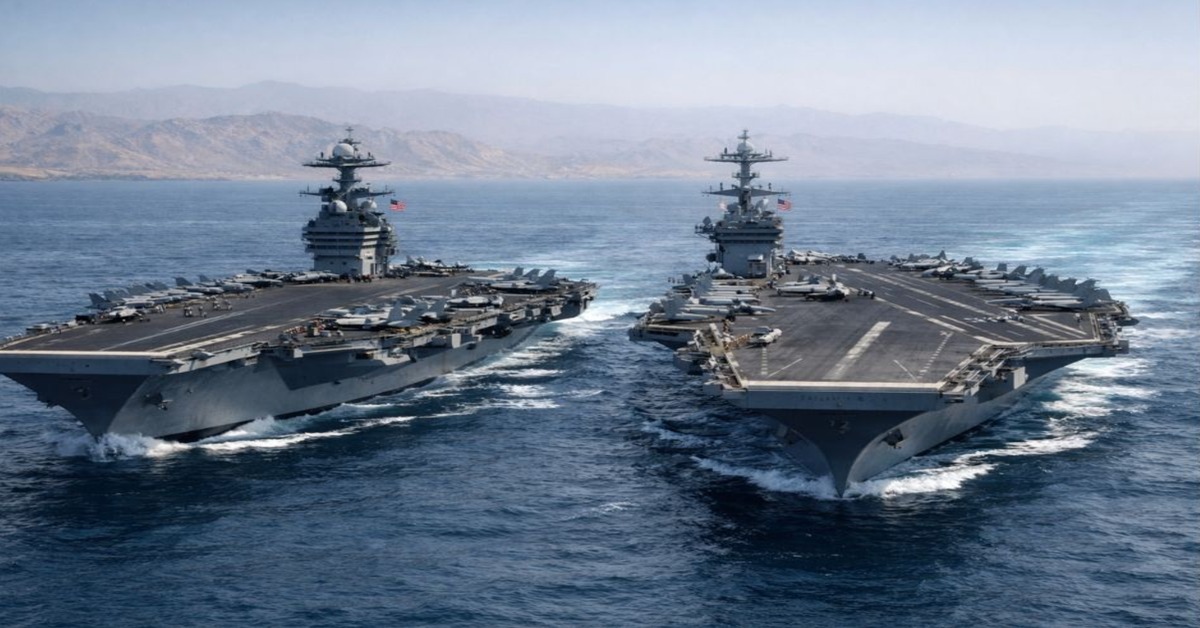
Operations at this level are never simple. They demand serious planning. They require coordination across multiple branches. They depend on discipline at every layer of command. Still, when you look closely, one factor rises above the rest. America’s supercarriers carried the weight of the mission. When two of these giants operate in the same theater at the same time, it is not about showmanship. It is about building total and lasting control. That is the difference.
Even one carrier strike group is among the most powerful mobile military forces anywhere in the world. A carrier functions as a floating air base powered by nuclear reactors and staffed by thousands of trained professionals. It is an extraordinary machine. Yet it still has limits. Aircraft must go through maintenance cycles. Pilots cannot fly without rest. Deck crews need time to reset between launch and recovery operations. No ship, no matter how advanced, can maintain maximum intensity every minute of every day.
That reality creates a weakness. The idea behind a dual carrier presence is to close that gap.
When only one carrier handles high-tempo flight operations, it has to rotate between sending aircraft out and bringing them back. Those rotations create pauses. With two carriers in the same region, the tempo changes completely. One ship works while the other resets. The workload is divided across the clock. One carrier takes the night cycle. The other runs daylight operations. When one flight deck slows down, the other keeps jets overhead, sensors active, and strike options ready with alert crews. The pressure never disappears. It stays constant.
Naval planners describe this as sustained combat rhythm. It sounds technical, but the idea is straightforward. Instead of throwing a few dramatic punches and stepping back, forces apply steady pressure that does not let up. There is no window for recovery. There is no quiet stretch. The opposing side feels strain around the clock. With the USS Abraham Lincoln and the USS Gerald R. Ford operating in the same region on offset schedules, the United States maintained a continuous air presence. That means a massive number of sorties and response times that one carrier simply could not match.
VISIT OUR YOUTUBE CHANNELTo really grasp why two carriers matter, you have to look beyond raw firepower. Weapons matter. Aircraft matter. Technology matters. The deeper issue modern planners focus on is endurance. Strength that fades loses its edge. Strength that holds steady changes the outcome.
@modernfoos.14
@modernfoos.14
Once both carriers are in place, the advantage becomes clear. The staggered rhythm divides the day into defined operational blocks. Each ship controls its portion of the clock. Together, they create an unbroken cycle of presence, surveillance, and strike capability. The result is dominance that does not blink.
@modernfoos.14
@modernfoos.14
#usnavy #militarypower #americafirst