


You know it’s 2025 when politicians can’t agree on much—except that talking about sensitive stuff should happen on an encrypted app… preferably one they already use. Yep, we’re talking about Signal, the app that’s apparently more bipartisan than your grandma’s potato salad.
Democrats have been singing Signal’s praises since before it was cool—or at least before the Trump team started using it to coordinate counterterrorism ops. Seriously.
Texas Rep. Jasmine Crockett even told a Human Rights Campaign crowd in L.A. this past Saturday:
“We have all these Signal chats. If you don’t have Signal, get on Signal, okay? Do not trust …. get on Signal.”
WATCH:
Very subtle, Congresswoman.
VISIT OUR YOUTUBE CHANNELShe was specifically referencing protected discussions like her “Dem women’s caucus chat,” which honestly sounds like a spicy risque group chat in DC.
But suddenly, the internet—and Capitol Hill—caught fire after a Signal group chat involving top national security leaders (plus Jeffrey Goldberg from The Atlantic of all people) discussed striking terrorists in Yemen. Yes, that Jeffrey Goldberg. The same guy who turned it into clickbait gold with the headline:
“The Trump Administration Accidentally Texted Me Its War Plans.”
You can’t make this up. But Goldberg can because that’s what he allegedly did.
Here’s all you need to know about Jeffrey Goldberg:
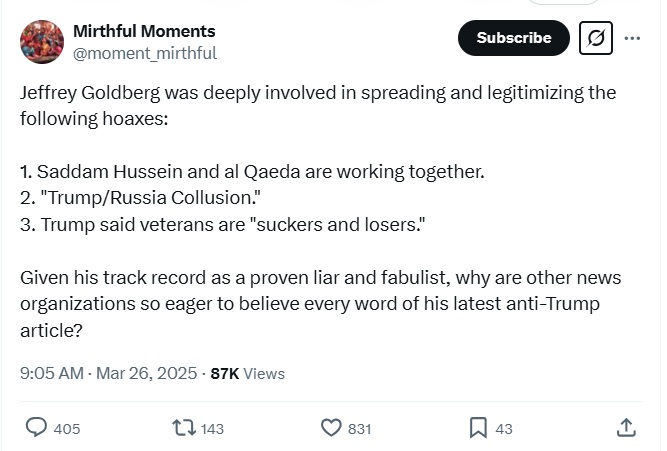
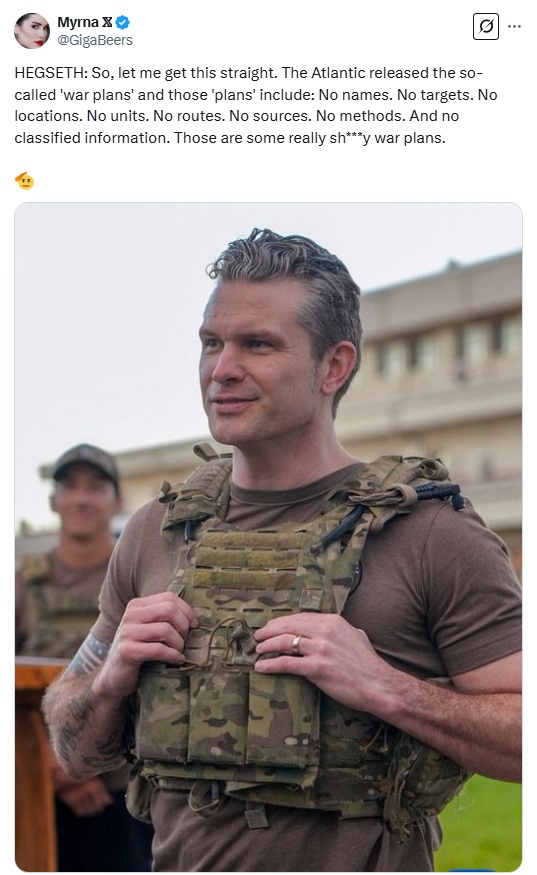
The Trump team fired back immediately, saying nothing classified was leaked and calling The Atlantic’s article a total fairy tale. Pete Hegseth, Secretary of Defense, even jumped on X to drop this absolute scorcher:
“So, let me get this straight. The Atlantic released the so-called ‘war plans’ and those ‘plans’ include: No names. No targets. No locations. No units. No routes. No sources. No methods. And no classified information.”
WATCH:
“Those are some really sh—y war plans. This only proves one thing: Jeff Goldberg has never seen a war plan or an ‘attack plan’ (as he now calls it). Not even close. As I type this, my team and I are traveling the INDOPACOM region, meeting w/ Commanders (the guys who make REAL ‘war plans’) and talking to troops. We will continue to do our job, while the media does what it does best: peddle hoaxes.”
The Atlantic doubled down, pointing to a screenshot showing Hegseth’s messages about drones and combat aircraft. The piece warned:
“If this information—particularly the exact times American aircraft were taking off for Yemen—had fallen into the wrong hands in that crucial two-hour period, American pilots and other American personnel could have been exposed to even greater danger than they ordinarily would face.”
And, of course, it was nonsense. The issue of an attack was already out, and everyone who was anyone already knew it.
But Signal isn’t just for war games. Over in DC, it’s become the go-to for politicians, especially since word got out last October that Chinese-linked hackers were sniffing around U.S. cellphone data. That included phones used by Donald Trump and VP JD Vance during the campaign, according to Politico.
So yeah, Democrats were already riding the Signal train long before this mess. Back in 2016, during the Hillary vs. Trump face-off, the DNC was practically handing out Signal tutorials like Halloween candy.
“Signal, staffers in the meeting were told, was ‘Snowden-approved.’ A week after the meeting at the campaign headquarters, according to two people who have worked with the D.N.C. and the Clinton campaign, an e-mail was sent out instructing staffers where to download the app and how to use it.”
By 2018, the DNC’s tech advisor told Politico:
“They chat via the encrypted messaging apps Signal and Wickr with cyber experts from the DNC’s sister committees and third-party vendors, discussing suspicious incidents and other information.”
Even back in 2017, Sen. Ron Wyden was practically giving out gold stars for encryption.
“With the transition to default HTTPS for all of the other Senate websites and the recent announcement by your office that the end-to-end encrypted messaging app Signal is approved for Senate staff use, I am happy to see that you too recognize the important defensive cybersecurity role that encryption can play.”
So when Wyden recently demanded that Hegseth and National Security Advisor Mike Waltz resign over the Signal messages, it raised a few eyebrows.
Meanwhile, journalists love Signal too—The Washington Post and The New York Times both use it for anonymous tips. Loudoun County Democrats even told people in February:
“Federal workers and active Democratic volunteers would be wise to make use” of Signal. The post came with a handy “how-to” guide, in case your grandma needed to report a scandal from her knitting circle.
House Oversight Dems also created a Signal tip line for reporting anything Trump 2.0-related, warning people:
“Do not submit classified information or other information barred from release through this form, by email, or by the Signal app.”
Classic D.C.—”Use this tool, but don’t actually use it for anything important.”
According to Fox News, Sen. Mark Warner—who publicly slammed the Trump officials over Signal—used the app himself to chat with a lobbyist tied to a Russian oligarch. They were trying to get in touch with (wait for it)… Christopher Steele. Yes, that Christopher Steele, the ex-British spy who hates Donald Trump and went along with the Obama coup to take down Trump’s 2016 campaign.
A Senate GOP aide tossed out this grenade:
“Signal worked great for Senator Warner when he wanted to meet with the disgraced liar Christopher Steele. It’s a little surprising Warner is pretending to be so upset about it today.”
Warner’s spokesperson fired back:
“The fact that Fox News is in possession of these messages demonstrates exactly why Signal shouldn’t be used to discuss classified national security material like war plans.” Except, there was no classified national security material exposed during the chat.
So, fair enough… except apparently, everyone’s been using it anyway.
Even the federal government itself has been telling people to get on Signal. CISA (the cybersecurity arm of DHS) released a 2024 guide saying Signal is a “best practice” for high-risk government folks—aka the exact type of people who’d be tempted to send a war plan text.
The guide reads:
“Adopt a free messaging application for secure communications that guarantees end-to-end encryption, such as Signal or similar apps… These apps typically support one-on-one text chats, group chats with up to 1,000 participants, and encrypted voice and video calls. Additionally, they may include features like disappearing messages and images, which can enhance privacy.”
But don’t get too comfy. A 2023 memo from the Department of Defense made clear that even though Signal was approved for some use, it’s a no-go for anything remotely classified.
And yet, the White House itself is like, “Yeah, we like it.” Press secretary Karoline Leavitt said this week:
Signal is an “approved app” for government employees, citing that the “CIA has it loaded onto government phones because it is the most secure and efficient way to communicate.”
CIA Director John Ratcliffe confirmed that when he testified on Tuesday:
“One of the first things that happened when I was confirmed as CIA director was Signal was loaded onto my computer at the CIA, as it is for most CIA officers, one of the things that I was briefed on very early, Senator, was by the CIA records management folks about the use of Signal as a permissible work use.”
So what do we take from all this?
Signal is the spy tool everyone swears by—until someone they don’t like uses it. Then it’s either a hoax, a scandal, or a national security disaster. Pick your headline.
Either way, here’s your takeaway: If you’re in Washington, don’t say anything on Signal you wouldn’t want to be leaked… unless you’re absolutely sure it’ll help you own your political opponents.
Nothing says “secure” like 1,000 people in a group chat. #eyeroll
#signalapp #politicaldrama #dcsecrets