


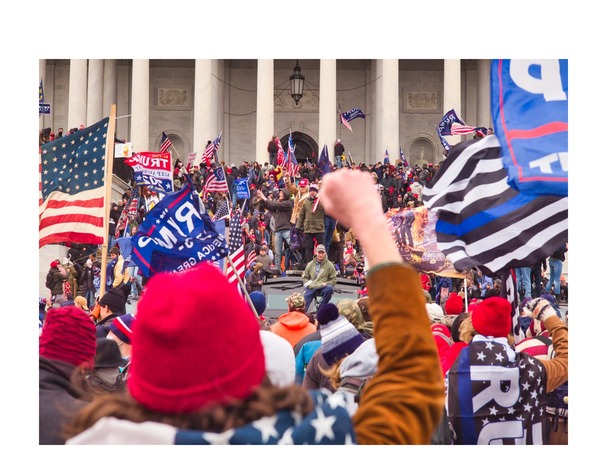
Provocateurs infiltrated the throng that marched to the United States Capitol on January 6, 2021, according to a US Capitol Police (USCP) employee testifying on January 11 at a criminal prosecution in US District Court in Washington, D.C.
“Isn’t it true that you had a lot of people, a large quantity of people walking down two streets that dead-ended at the Capitol?” Bradford Geyer, one of the lawyers defending defendant Richard Barnett, approached the officer, Capt. Carneysha Mendoza.
“Yes, sir,” she replied.
“Okay. And would it be fair to say that at least at some of the leading edges of that crowd, they contained bad people or provocateurs; is that fair?” Geyer inquired.
“It’s fair,” Mendoza remarked.
She shared Geyer’s assessment that the people were dangerous, vicious, and well-trained.
VISIT OUR YOUTUBE CHANNEL“Highly trained, violent people who work and coordinate together?” Geyer queried.
“Yes,” Mendoza replied.
“Highly trained violent people who work and coordinate to remove barriers, overwhelm police, and attack police?” Geyer inquired.
“Are you talking about did they do that during the event?” Mendoza was perplexed.
“Yes,” Geyer said.
“They did,” Mendoza said.
The 20-year veteran of the USCP, who manages around 300 full-time police, stated that intelligence was received prior to Jan. 6 indicating that some groups were planned to join the rallies in order to irritate the crowds.
“Affirmative; that’s correct,” Mendoza replied.
“That’s typical for any protest that we do. I’ve been doing protests for 20 years, and that’s typical of any protest. There’s usually a group and a counter-group or a group and several counter-groups. So that’s typical, yes,” she continued.
Barnett, of Gravette, Arkansas, was pictured with his foot on a desk in Nancy Pelosi‘s office (D-CA).
He is facing three charges related to the breach of the United States Capitol, including knowingly entering or remaining in any restricted building or grounds while armed with a dangerous weapon, violent entry and disorderly conduct on Capitol grounds, and theft of public money, property, or records. Barnett pleaded not guilty and turned down a plea deal from prosecutors in 2022.
Since January 6, the USCP intelligence section has been heavily chastised for failing to share its late-breaking threat analyses beyond the top tier of commanders.
According to a report prepared by Republican members of the United States House in December 2022, the Capitol Police Intelligence and Interagency Coordination Division (IICD) should have expected better.
“Prior to that day, the U.S. Capitol Police (USCP) had obtained sufficient information from an array of channels to anticipate and prepare for the violence that occurred. However, officers on the front lines and analysts in USCP’s intelligence division were undermined by the misplaced priorities of their leadership. Those problems were exacerbated by the House Sergeant at Arms, who was distracted from giving full attention to the threat
environment prior to January 6, 2021, by several other upcoming events, the report stated. Intelligence was overseen by then-Assistant Chief Yogananda Pittman and managed by Julie Farnam.”
READ THE WHOLE REPORT:
People were told that the area behind the barricades was restricted after key areas of the Capitol complex were sealed off with bike racks joined together and snow fencing. During the trial, a map displayed a red line around the region, showing the boundary.
Mendoza claimed she walked around the Capitol’s perimeter the night before it was breached.
While Mendoza was on the witness, defense attorneys played film and displayed photographs of many persons pulling down the fencing and signage. Mendoza agreed that camera footage showed persons breaching the USCP fence.
“Some of the integrity of the perimeter was changed,” on the day of the breach, Mendoza testified.
Mendoza was supposed to return to work at 3 p.m. after a late night, but he received a call at about 1:30 p.m. from a coworker who asked where Mendoza’s team was located. Mendoza is in charge of the force’s civil disturbance squad. The colleague suggested that Mendoza come in early, causing the official to get in her car and drive to work.
Mendoza had no idea the Capitol had been breached until she arrived. She was allowed to enter a little-known door and pushed her way to a line of officers, but they were quickly “overrun.” The officers dispersed to various places and attempted to keep the rioters at bay. They also worked to remove rioters from the building using “less lethal” force, or measures that would not kill.
Officers eventually prevailed, with the assistance of federal and local law enforcement, and Congress was allowed to reconvene and certify the electoral vote from the 2020 election.
“So in your experience on that day and based upon what you learned from your colleagues earlier in the day, were there people there who pushed through barriers, removed barriers, threw barriers over the side, removed fencing, and eased the flow of people into places where they shouldn’t be?” Geyer inquired at one point.
“Yes,” Mendoza said.