





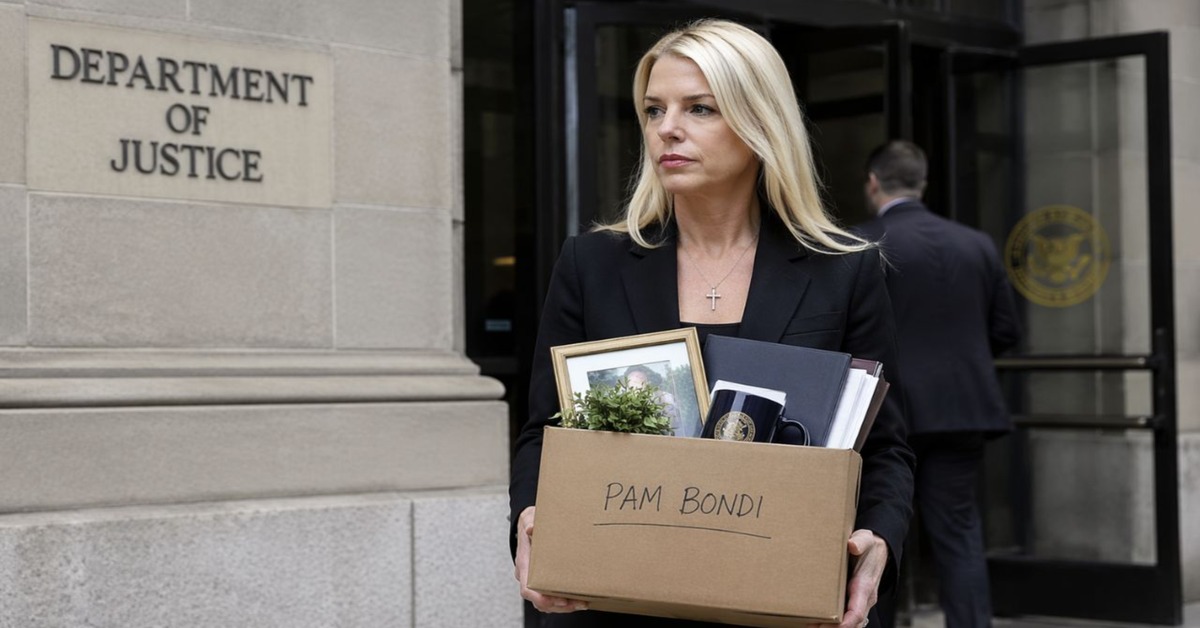
Thursday marked Day 400 since the moment many point to as the beginning of what they see as a major misstep involving the Epstein files under former Attorney General Pam Bondi. What was expected to be a serious and disciplined handling of sensitive material instead became, in the eyes of critics, a public relations fiasco that left even supportive voices frustrated and disillusioned.
Rumors have circulated about Bondi’s standing, including speculation that President Trump may have dismissed her. Some have tied that speculation to controversy surrounding Congressman Eric Swalwell, with claims about his personal conduct and alleged connections raising further questions about judgment and associations. Many believe Trump was angry with Bondi because she warned him that the FBI was looking at his activities. These rumors, whether verified or not, have only added fuel to an already tense situation.
Bondi served as attorney general for 14 months. In the context of a four-year presidential term, that represents a significant portion of time. Nearly thirty percent of a president’s term, to be exact. Critics argue that during that period, key expectations were not met. There were numerous high-profile controversies and allegations that, in their view, warranted investigation or prosecution but saw no action.
Among those concerns were accusations that Dr. Anthony Fauci misled Congress during testimony related to COVID-19. Despite public disputes over his statements, no prosecution followed. Similarly, allegations surrounding intelligence assessments tied to the 2016 election, including claims that figures like John Brennan were involved in misleading conclusions, did not result in legal action despite assertions that evidence had been presented.
Other flashpoints only deepen the concern, and they are not small or obscure. Take the Ukraine impeachment saga. That episode was presented to the public as a matter of urgent national security. Yet to many observers, it looked more like a politically driven operation aimed at damaging Donald Trump than a neutral search for truth. Questions about selective leaks, shifting narratives, and the role of intelligence officials were never fully resolved. Then it simply moved on, with no real accountability for how it unfolded.
Then there is the issue of federal law enforcement. Across the country, parents who showed up at local school board meetings to voice concerns suddenly found themselves under scrutiny. These were not hardened criminals. These were mothers and fathers worried about curriculum, discipline, and policies that affected their children. Some raised objections to gender policies that allowed biologically male students into girls’ bathrooms and locker rooms. Instead of being heard, many felt they were treated as potential threats. Reports of involvement by the Federal Bureau of Investigation raised serious concerns about whether government power was being used to intimidate ordinary citizens.
VISIT OUR YOUTUBE CHANNELAnd then there is the treatment of journalists tied to Project Veritas. Their work often targeted powerful institutions, which is supposed to be the role of investigative journalism in a free society. Yet critics argue they were subjected to aggressive legal pressure and enforcement actions that seemed disproportionate. The question many asked was simple. Would the same treatment have been applied if the reporting had aligned with establishment narratives?
The concerns expand further. Certain religious groups were reportedly flagged in internal discussions as potential extremist threats. For many Americans, that crosses a line. Practicing faith has long been considered a protected right, not a reason for suspicion. At the same time, the handling of January 6 defendants raised additional questions. Some argue that penalties and pretrial conditions appeared inconsistent when compared to other cases involving political violence, creating the perception of unequal justice.
Then came the revelations from the Twitter Files. Internal communications suggested coordination between government agencies and major social media platforms. Content moderation decisions were not always made independently. Instead, there were indications that officials influenced what information could be seen or shared. For critics, that raised a fundamental issue about free speech. If the government can quietly shape online discourse, then the line between public debate and controlled messaging becomes very thin.
Taken together, these episodes form a pattern that many find difficult to ignore. Each one, on its own, might be explained away. But when viewed as a whole, they point to a deeper concern about how power is used and who is held accountable when that power is questioned.
The list does not end there. It keeps growing, and each new example raises more questions than answers. Take the raid on Mar-a-Lago. When federal agents executed that search, it was presented as a necessary legal action. But to many Americans, it looked unprecedented. A former president, Donald Trump, had his home searched in a way that had never been done before in modern history. Critics immediately asked whether the same standard would be applied across the board. Would other political figures be treated the same way under similar circumstances? That question still lingers.
At the same time, there are ongoing concerns about conduct inside federal agencies. Whistleblower claims, internal disputes, and reports of politicized decision-making have fueled a growing belief that some institutions may not be operating as neutrally as they should. Whether those claims are fully proven or not, the perception alone has been enough to shake confidence.
Then there is the issue of violent extremist groups. Critics argue that enforcement has been uneven. Some groups appear to face intense scrutiny, while others seem to operate with far less attention. When law enforcement appears inconsistent, people begin to wonder if the rules are being applied fairly or selectively, depending on who is involved.
Meanwhile, high-profile legal battles continue to dominate headlines. Figures like Alvin Bragg, Fani Willis, and Letitia James have all taken center stage in cases tied to Trump and his allies. Supporters of those actions argue they are simply enforcing the law. Critics see something different. They see a pattern where certain individuals are pursued aggressively, while others facing serious accusations seem to avoid scrutiny.
There are also ongoing allegations of fraud and misconduct involving various public officials that, according to critics, have not received the same level of attention or urgency. That imbalance is what fuels the broader concern. It is not just about any single case. It is about the overall pattern.
And that pattern, to many observers, looks like selective enforcement. Laws that are supposed to apply equally begin to feel conditional. Accountability appears inconsistent. When that perception takes hold, trust begins to break down.
At the core of all this frustration is something very simple. Accountability. That was the expectation. Many voters backed Donald Trump because they believed long-standing abuses inside government would finally be investigated and prosecuted, and not talked about, not hinted at. Actually acted on. Instead, critics point out that not one major case produced real consequences. No meaningful prosecutions. No clear sense that the system had been corrected.
That lack of action has done real damage to trust. People notice when promises do not turn into results. They notice when serious allegations fade away without resolution. And in that environment, confidence starts to slip. Some critics argue that Pam Bondi appeared more focused on media visibility than on delivering outcomes. Frequent appearances on outlets like Fox News gave the impression of messaging over substance. Then came claims that she spoke publicly about the Epstein files without fully reviewing them. Whether accurate or not, that perception made skepticism grow even stronger.
But the frustration runs deeper than missed chances. It is about what those missed chances signal. When allegations of corruption are not pursued, people conclude. They begin to believe that certain behavior carries no real risk. That the system protects itself. Critics argue that this creates a dangerous precedent. If no one is held accountable, then there is no incentive for anything to change.
That is where the concern becomes long-term. Without structural reforms that limit abuse of power, the same cycle continues. It does not matter which party is in charge. The machinery remains the same. And if the machinery remains the same, then the outcome does too.
This concern grows even stronger when you listen to the rhetoric coming from political opponents. It is not subtle. Public figures, commentators, and even some elected officials have openly talked about using the legal system to go after those connected to Donald Trump and the wider political movement around him. These are not offhand remarks. They are repeated statements that suggest a willingness to turn political conflict into legal action.
Some of the language has been especially striking. There have been comparisons to historical “denazification” efforts, which carry a very specific and serious implication. Others have gone further, predicting that members of Trump’s family could face prosecution. When that kind of rhetoric becomes normalized, it changes how people view the role of government power. It starts to look less like neutral enforcement and more like a tool that can be used against political opponents.
In that kind of environment, inaction takes on a different meaning. It is no longer just disappointing. It becomes a real weakness. Critics argue that failing to address potential abuses now leaves the door open for those same tactics to be used later, and used more aggressively. Power does not disappear. It gets transferred. And if the rules are not clearly defined and enforced, whoever holds that power next can push it even further.
That is the deeper concern. If systemic problems are left unresolved, future administrations will not hesitate to use every available tool. And they may use those tools in ways that go far beyond anything seen before.
In the end, this debate comes down to a basic question about how a country is governed and how justice is applied. Is it enough to win elections, or does real change require rebuilding the institutions that hold power? That is the question no one can avoid. Because if the structure stays the same, then the outcomes will not change for long.
There is another reality that many people already understand. Much of what the Donald Trump administration accomplished could be reversed almost immediately by the next Democratic administration. Executive orders can be undone. Policies can be rewritten. Priorities can shift overnight. That is not speculation. That is how the system is designed to work. The real question is whether anything lasting has been put in place that cannot be easily undone.
And here is where the silence becomes noticeable. Who is seriously talking about making accountability permanent? Not temporary. Not dependent on who holds office. Permanent. A standard that applies no matter which party is in power. Because without that, everything becomes cyclical. One administration pushes in one direction. The next one pulls it back. Nothing is ever fully resolved.
For many observers, the conclusion is straightforward. Without real accountability and meaningful reform, the same problems will continue to exist. The same patterns will repeat. And when they repeat, the consequences will not be limited to a single presidency. They will shape the direction of the country for years to come.
Pam Bondi had to go. Let’s hope Trump has the wisdom to replace her with someone who will get done what needs to be done to repair and save our republic.
#accountabilitycrisis #epsteinfiles #politicaljustice



What went wrong with Pam Bondi?
Easy…..woman in a man’s job.
Sessions…Barr…Bondi. THREE utter disasters appointed by Trump. I have no idea why he allows them to keep their positions for SO long in the face of such overt negligence and incompetence. Worse, Blanche has a reputation for defending the Deep State…so it looks like another Sessions-to-Barr appointment. I hope I’m wrong because Americans NEED to see justice done after SO many years.
She was afraid of what libs would do to her if she prosecuted one of their higher-ups.
Hangfire Blondie, still no miscreants in prison with SO many to choose from