

President Donald Trump says the next move on birthright citizenship should happen in Congress after Tuesday’s Supreme Court decision went against his administration.
Personally, I think it went against common sense and the American Constitution.
Instead of trying to change the Constitution, Trump believes lawmakers should pass legislation that limits birthright citizenship. He laid out that argument in a post on Truth Social.
“The Supreme Court upheld Birthright Citizenship, which is too bad for our Country, but we can easily make it up in Congress through Legislation, with the support of the President, that has now been determined during this process,” he said in a Truth Social post.
“No long and unwieldy Constitutional Amendment is necessary! Congress should start TODAY to work on ending expensive and unfair to our Country, Birthright Citizenship. They will have my Complete and Total Support!” he added.
VISIT OUR YOUTUBE CHANNELThe Supreme Court’s ruling leaves birthright citizenship in place under its current interpretation. Writing for the majority, Chief Justice John Roberts pointed back to the language of the Fourteenth Amendment, stating that “the Framers of the Fourteenth Amendment extended that promise to ‘every free-born person in this land.’”
The words of the Chief Justice of the United States show that he really does not understand what the Birthright Citizenship Clause in the 14th Amendment meant to the framers. In fact, they meant the exact opposite.
Here is Section 1 of the Fourteenth Amendment:
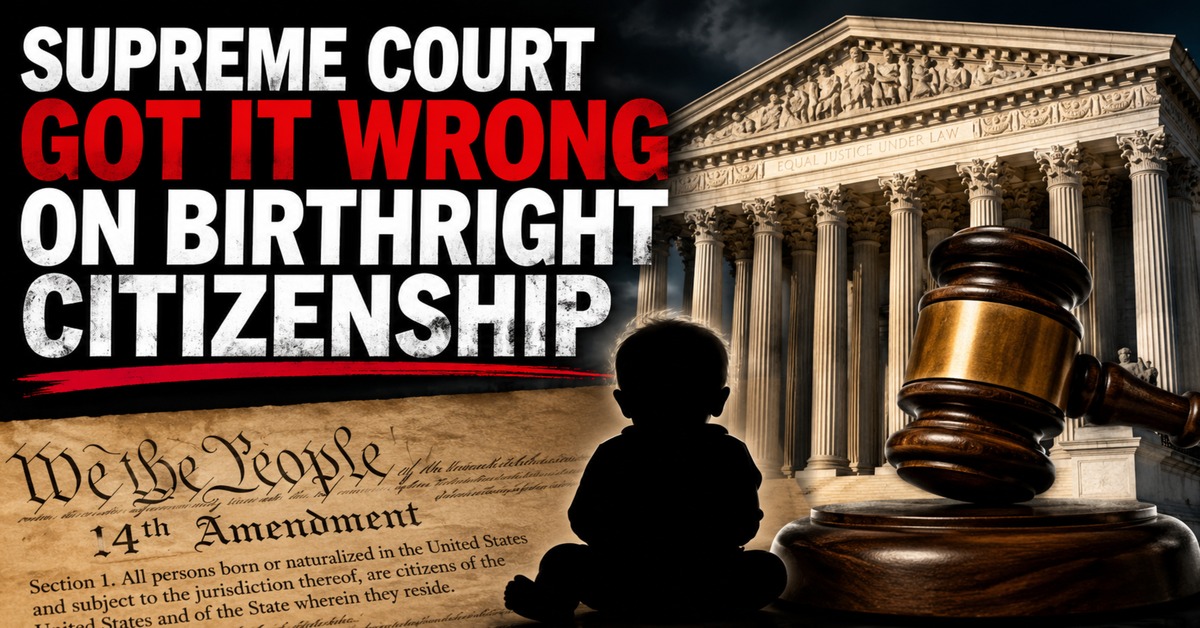
All persons born or naturalized in the United States, and subject to the jurisdiction thereof, are citizens of the United States and of the State wherein they reside. No State shall make or enforce any law which shall abridge the privileges or immunities of citizens of the United States; nor shall any State deprive any person of life, liberty, or property, without due process of law; nor deny to any person within its jurisdiction the equal protection of the laws.
[emphasis added]
Senator Jacob Howard of Michigan, who introduced the Fourteenth Amendment to the US Senate, made it very clear what the citizenship clause means.
Here is what Howard said in front of the Senate body when referring to the Citizenship Clause:
“This will not, of course, include persons born in the United States who are foreigners, aliens, who belong to the families of ambassadors or foreign ministers accredited to the Government of the United States, but will include every other class of persons.”
[emphasis added]
Senator Lyman Trumbull of Illinois, as chairman of the Senate Judiciary Committee in 1866, who played a major role in the Civil Rights Act of 1866, said the term, “and subject to the jurisdiction thereof;” means “not owing allegiance to anybody else and being subject to the complete jurisdiction of the United States.”
[emphasis added]
The term “and subject to the jurisdiction” is one of the easier clauses in the Constitution to understand, which is why the Democrats are lying about it. What it means is that your parents have to have an allegiance to the United States in order for you to be a US citizen by being born here. If the parents are still subject to the jurisdiction of another country, then the baby born here is also not subject to the jurisdiction of the United States. Subject to the jurisdiction doesn’t mean that you are here on our soil. It is an allegiance to the country.
Think about this for a minute. When someone becomes a naturalized U.S. citizen, they don’t just fill out paperwork and walk away. They stand before the government and take an oath. In that oath, they formally renounce their allegiance to every other country and pledge their loyalty to the United States and to the Constitution.
That’s an important point in this debate. Supporters of changing birthright citizenship argue that a child born here automatically becomes a citizen without ever making that pledge. A baby can’t take a pledge, which is why the jurisdiction is based on the parents.
The legal fight began with an Executive Order signed at the start of President Trump’s second term. The administration argued that “the Fourteenth Amendment has never been interpreted to extend citizenship universally to everyone born within the United States.”
According to that Executive Order, automatic U.S. citizenship should not apply to children born in the United States if their mother was in the country illegally and “the person’s father was not a United States citizen or lawful permanent resident at the time of said person’s birth,” or if the child’s “mother’s presence in the United States was lawful but temporary, and the person’s father was not a United States citizen or lawful permanent resident at the time of said person’s birth.”
The debate has now shifted from the courtroom to Capitol Hill. Some Republican lawmakers are already pushing Congress to act.
“Extremely disappointed to see this decision come out of the Supreme Court today,” Sen. Katie Britt (R-AL) posted to X.
“Congress must take action and end unlimited birthright citizenship immediately. The majority of the globe does not recognize this form of citizenship that has been grossly exploited to the detriment of our country,” she added.
Extremely disappointed to see this decision come out of the Supreme Court today.
Congress must take action and end unlimited birthright citizenship immediately. The majority of the globe does not recognize this form of citizenship that has been grossly exploited to the… https://t.co/vQgvOeRsaO
— Senator Katie Boyd Britt (@SenKatieBritt) June 30, 2026
In the spirit of humor, Trump also truthed out a message to SCOTUS:
What the president is talking about is what’s often called “birth tourism.” Critics argue that for years, some Chinese nationals have traveled to the United States or U.S. territories specifically to give birth so their children receive U.S. citizenship. After the child is born, the family returns to China, where the child grows up.
Supporters of changing birthright citizenship point out that, because those children are U.S. citizens, they can legally return to the United States as adults and exercise the rights that come with citizenship, including voting if they meet all legal requirements.
At first glance, that may not sound like a major issue. But supporters of reform ask a different question. What happens if this occurs on a much larger scale? What if tens of thousands of children receive U.S. citizenship this way every year for more than a decade? They argue that the long-term impact could be significant, which is why they believe Congress should revisit the nation’s birthright citizenship laws.
For supporters of the administration, the Court may have closed one path, but they see Congress as another. Whether lawmakers have enough votes to pass such legislation is a separate question, and that debate is likely to become one of the next major immigration battles in Washington.
#birthrightcitizenship #immigrationreform #trump2026