


On Thursday, the US Supreme Court handed down a ruling on racial preferences in college admissions, a racist practice that has harmed Asian students.
Associate Justice Ketanji Brown Jackson, President Joe Biden‘s Supreme Court nominee, spoke out strongly in her dissent against Thursday’s ruling that struck down the racial preference scam that is going on in college admissions.
Brown accused the Court’s six conservative justices of believing that the United States is a “colorblind” culture and of ignoring widespread racial inequities that exist even in the absence of official racial discrimination statutes.
She traced the history of black suffering in America, from enslavement to sharecropping, Jim Crow to redlining, concluding:
“The race-based gaps that first developed centuries ago are echoes from the past that still exist today.”
She went on to say:
VISIT OUR YOUTUBE CHANNELTo demand that colleges ignore race in today’s admissions practices—and thus disregard the fact that racial disparities may have mattered for where some applicants find themselves today—is not only an affront to the dignity of those students for whom race matters. It also condemns our society to never escape the past that explains how and why race matters to the very concept of who “merits” admission.
Jackson is talking about the concept of “disparate impact,” which is a term not unlike the equally goofy accusation of “institutional racism,” which is a term that leftists use when they cannot identify an actual racist that can explain the failures of black people.
An example of disparate impact would be if there are not enough black people in a specific profession, leftists would claim it’s due to racism. They make this claim even when the reason why there are not enough black people in the profession is due to not enough black people wanting to be in the profession.
Dr. Thomas Sowell often talked about how affirmative action programs in schools like Harvard and Yale do a real disservice to the majority of black students who are accepted through affirmative action programs. Sowell points out that in many cases, black students would do well in universities that were not Ivy League and would go on to have successful, thriving lives. He pointed out that in many cases, black students who did not earn the right to go to Harvard or Yale or Princeton or many of the other Ivy League universities would fail out miserably because they just weren’t readily prepared for that level of academia. That doesn’t mean they’re stupid. A majority of white people wouldn’t be able to get through Harvard either. Thomas Sowell is a black Harvard graduate and one of my favorite authors.
Describing the use of race in admissions at Harvard and the University of North Carolina as a “plus” factor – while ignoring the burden put on Asian Americans and others harmed by the policy, – she argued that using race in college admissions policies had “universal” benefits, not just for the beneficiaries.
She added:
“Do not miss the point that ensuring a diverse student body in higher education helps everyone, not just those who, due to their race, have directly inherited distinct disadvantages with respect to their health, wealth, and wellbeing.”
She insisted:
“Race blindness… will postpone the day when every American, regardless of race, has an equal opportunity to thrive.”
She came to the following conclusion:
With let-them-eat-cake obliviousness, today, the majority pulls the ripcord and announces “colorblindness for all” by legal fiat. But deeming race irrelevant in law does not make it so in life. And having so detached itself from this country’s actual past and present experiences, the Court has now been lured into interfering with the crucial work that UNC and other institutions of higher learning are doing to solve America’s real-world problems.
No one benefits from ignorance. Although formal racelinked legal barriers are gone, race still matters to the lived experiences of all Americans in innumerable ways, and today’s ruling makes things worse, not better. The best that can be said of the majority’s perspective is that it proceeds (ostrich-like) from the hope that preventing consideration of race will end racism. But if that is its motivation, the majority proceeds in vain. If the colleges of this country are required to ignore a thing that matters, it will not just go away. It will take longer for racism to leave us. And, ultimately, ignoring race just makes it matter more.
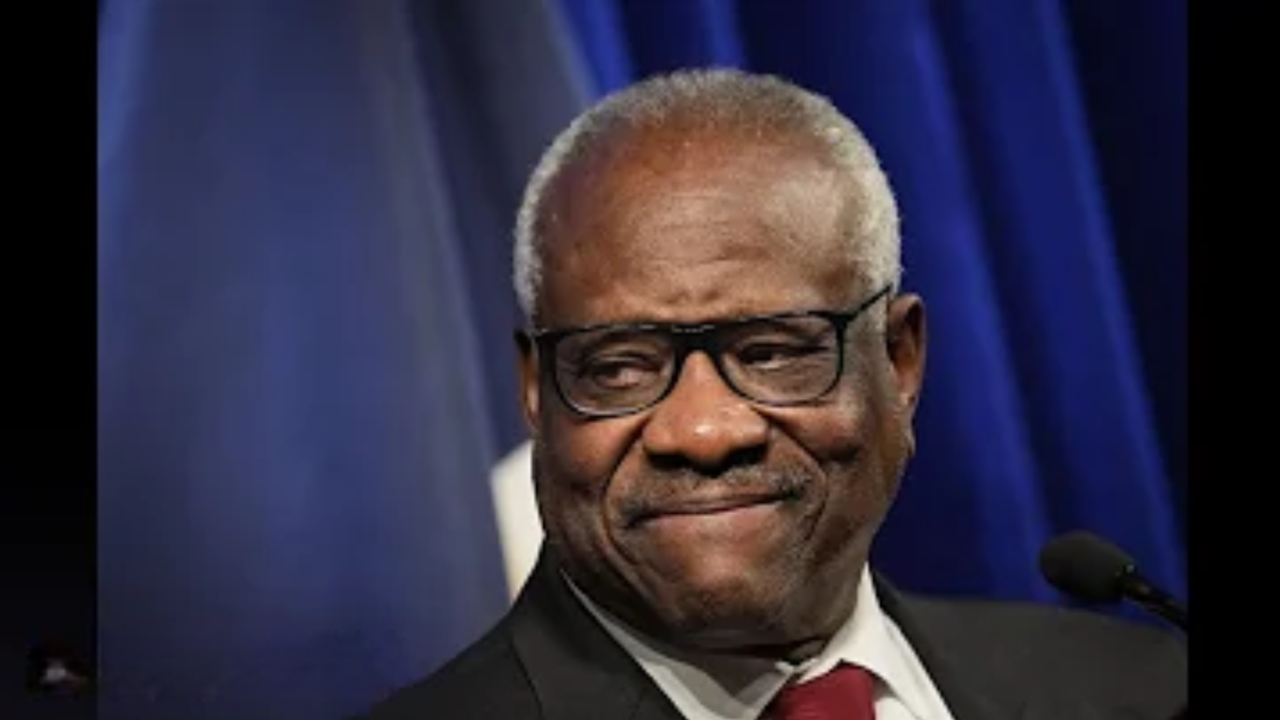
Justice Clarence Thomas addressed Justice Jackson’s dissent in a concurring opinion he wrote. While acknowledging that “our society is not, and has never been, colorblind,” he said that the Constitution is.
In other words, Justice Thomas said that the law is colorblind. Try to explain that to the AOCs of the world.
He asserted:
JUSTICE JACKSON would replace the second Founders’ vision with an organizing principle based on race. In fact, on her view, almost all of life’s outcomes may be unhesitatingly ascribed to race. …
This lore is not and has never been true. Even in the segregated South where I grew up, individuals were not the sum of their skin color. Then as now, not all disparities are based on race; not all people are racist; and not all differences between individuals are ascribable to race. … Worse still, JUSTICE JACKSON uses her broad observations about statistical relationships between race and select measures of health, wealth, and well-being to label all blacks as victims. Her desire to do so is unfathomable to me. I cannot deny the great accomplishments of black Americans, including those who succeeded despite long odds.
JUSTICE JACKSON then builds from her faulty premise to call for action, arguing that courts should defer to “experts” and allow institutions to discriminate on the basis of race. Make no mistake: Her dissent is not a vanguard of the innocent and helpless. It is instead a call to empower privileged elites, who will “tell us [what] is required to level the playing field” among castes and classifications that they alone can divine. … Then, after siloing us all into racial castes and pitting those castes against each other, the dissent somehow believes that we will be able—at some undefined point—to “march forward together” into some utopian vision. … Social movements that invoke these sorts of rallying cries, historically, have ended disastrously.
Unsurprisingly, this tried-and-failed system defies both law and reason.…
While articulating her black and white world (literally), JUSTICE JACKSON ignores the experiences of other immigrant groups (like Asians, see supra, at 43–44) and white communities that have faced historic barriers. Though JUSTICE JACKSON seems to think that her race-based theory can somehow benefit everyone, it is an immutable fact that “every time the government uses racial criteria to ‘bring the races together,’ someone gets excluded, and the person excluded suffers an injury solely because of his or her race.” Parents Involved, 551 U. S., at 759 (THOMAS, J., concurring) (citation omitted). Indeed, JUSTICE JACKSON seems to have no response—no explanation at all—for the people who will shoulder that burden. How, for example, would JUSTICE JACKSON explain the need for race-based preferences to the Chinese student who has worked hard his whole life, only to be denied college admission in part because of his skin color? If such a burden would seem difficult to impose on a bright-eyed young person, that’s because it should be. History has taught us to abhor theories that call for elites to pick racial winners and losers in the name of sociological experimentation.
Nor is it clear what another few generations of race-conscious college admissions may be expected to accomplish. Even today, affirmative action programs that offer an admissions boost to black and Hispanic students discriminate against those who identify themselves as members of other races that do not receive such preferential treatment. Must others in the future make sacrifices to re-level the playing field for this new phase of racial subordination? And then, out of whose lives should the debt owed to those further victims be repaid? This vision of meeting social racism with government-imposed racism is thus self-defeating, resulting in a never-ending cycle of victimization. There is no reason to continue down that path. In the wake of the Civil War, the Framers of the Fourteenth Amendment charted a way out: a colorblind Constitution that requires the government to, at long last, put aside its citizens’ skin color and focus on their individual achievements.
Someone call 911. Justice Thomas just killed a progressive legacy.