


President Joe Biden recently outdid himself, creating another new low in what can only be described as “legal mayhem” by issuing preemptive pardons to people who committed crimes for him either as a private citizen, a US senator, vice president, and/or president. Joe was busy over the years. Big guy, isn’t he?
I submit that if Attorney General Pam Bondi were to petition the US Supreme Court to test the legality of preemptive pardons, the High Court might rule that they are unconstitutional. That’s not me using conjecture but based on the Constitution and past interpretations.
Here is Article II, Section 2, Clause 1:
“The President shall be Commander in Chief of the Army and Navy of the United States, and of the Militia of the several States, when called into the actual Service of the United States; he may require the Opinion, in writing, of the principal Officer in each of the executive Departments, upon any Subject relating to the Duties of their respective Offices, and he shall have Power to grant Reprieves and Pardons for Offences against the United States, except in Cases of Impeachment.”
Let’s break it down step by step. According to the Constitution, the president’s clemency powers come with some strings attached. First off, clemency only applies to “offenses against the United States.” Translation: state crimes and civil claims (federal and state) are a big, fat “Nope. Sorry, Charlie.” Oh, and in cases of impeachment? Forget about it. So it means federal crimes only. Moving on.
The courts have also chimed in with their two cents. For example, the Supreme Court said clemency can only kick in after a crime has been committed. In other words, no “Hey, go commit this crime; I got you covered!”
VISIT OUR YOUTUBE CHANNELSorry, Joe. Not how it works.
In the case of Schick v. Reed, the Court ruled that clemency could include “any condition which does not otherwise offend the Constitution.” So, no pardoning someone on the condition that they paint the White House pink. (Although, wouldn’t that be a reason to drink?) Other no-nos? Interfering with vested third-party rights, like selling off forfeited property. Fun fact: if something’s already in the Treasury, you need Congress to get it back. Good luck with that.
Oh, and the courts threw in an exception for fines imposed by other government branches for contempt. However, they’ve also said the President can pardon someone facing criminal punishment for contempt of court. Consistency? What’s that?
Here’s where it gets interesting. A full pardon, when accepted, “prevents or removes any of the penalties and disabilities consequent upon conviction.”
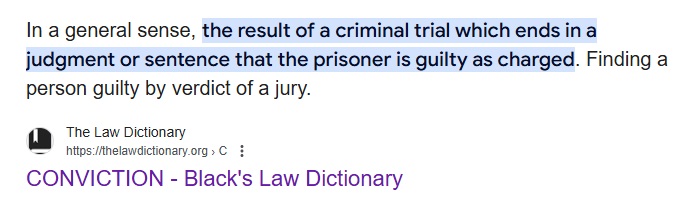
Black’s Law Dictionary defines “CONVICTION” as
“In practice. In a general sense, the result of a criminal trial which ends in a judgment or sentence that the prisoner is guilty as charged.”
The US Supreme Court wrote that the broad power conferred
in the Constitution gives the President plenary authority
to ‘forgive’ [a] convicted person in part or entirely, to reduce a penalty in terms of a specified number of years, or to alter it
with certain conditions.4 [emphasis added]
The only person Biden pardoned who fits that definition is his son Hunter.
And then there is common sense. The Founding Fathers would not have given a president the power to issue a pardon before a person is convicted of a crime. With that type of plenary power, a president could issue a blanket pardon for every citizen in the country. That’s just plain nuts.
Leave it to the Democrats to abuse any part of the justice system so that they can have a rigged game.
So, while Joe’s playing legal poker with these pardons, the courts might just call his bluff. And if they do? Well, let’s just say that the Biden regime’s criminals might see their day in court after all.
#bidenpardons #constitutionalcrisis #supremecourtshowdown