

For eleven nights in a row, American airstrikes hit targets along Iran’s coastline. At the same time, a naval blockade placed growing pressure on the Iranian economy. The regime was reportedly losing large amounts of oil revenue. The value of Iran’s currency was said to be falling rapidly, while inflation continued to rise. Meanwhile, President Trump was reportedly considering attacks against assets Tehran once assumed the United States would never touch.
From the outside, these actions may seem scattered or poorly connected. The argument presented by the source offers a different explanation. It suggests each move belongs to a broader plan. That strategy is designed to reduce Iran’s military strength while damaging its economy. It also places growing political pressure on the regime.
The source claims U.S. Central Command carried out major attacks against Iranian coastal infrastructure during the previous 24 hours. Several command centers were reportedly destroyed. Iranian missile and drone launch sites were also said to have been hit. The strikes reportedly eliminated important air defense systems as well. These attacks were not only meant to weaken Iran’s remaining forces. Their larger purpose was to reduce Tehran’s ability to threaten shipping near the Strait of Hormuz, which remains one of the world’s most important routes for transporting energy.
Bandar Abbas, Qeshm Island, and Greater Tunb Island are identified as important targets in this operation. According to the source, these locations play major roles in Iran’s coastal defense network and naval operations. Another striking claim involves the first reported use of American unmanned surface vessels in combat. The source says these vessels attacked a submarine facility and a ship maintenance site along the Iranian coast. This was not presented as a publicity stunt. It was described as evidence that Washington was willing to introduce new military systems into the conflict.
The analysis also gives special attention to a location called Pickaxe Mountain.
Earlier attacks reportedly destroyed Iran’s main nuclear facilities at Fordow, Natanz, and Isfahan. After those strikes, the source claims Israeli intelligence discovered that Iran had transferred advanced centrifuges to a protected underground site near Natanz. The complex is said to be buried beneath granite. That would make it much harder to destroy than the facilities previously attacked.
VISIT OUR YOUTUBE CHANNELThis underground complex creates a serious military problem. According to the source, standard bunker-busting weapons may not have enough power to destroy it. That leaves only a small number of possible responses. One option would involve striking the same location many times. Another could require a commando raid. The final possibility would involve an exceptionally powerful weapon that government officials reportedly do not want to discuss in public. In this version of events, Pickaxe Mountain has become the heart of Iran’s backup nuclear program. It may also become the next major challenge facing the United States.
Military force is not the only part of the strategy.
The source places equal importance on economic pressure. It claims the American naval blockade is costing Iran close to half a billion dollars in daily oil revenue. American forces are also reportedly protecting commercial vessels passing through the region. This allows oil shipments to continue moving through the Strait of Hormuz. According to the analysis, that removes much of Iran’s ability to threaten the international economy.
The source calls this approach a “vice grip.”
Iran has spent years threatening to interrupt oil shipments whenever conflict increases in the region. The current strategy allegedly turns that threat into a weakness. Each time Tehran talks about closing the strait, it risks provoking more American attacks. The blockade also continues to reduce Iran’s own oil earnings. The regime’s most powerful bargaining tool may now cause more damage to Iran than to its opponents.
The source also argues that this growing pressure is exposing serious divisions within the Iranian government.
Iranian officials have publicly admitted that the country faces major economic trouble. The source also points to the falling value of the rial and reports of extremely high inflation. Some of the exact figures may be disputed. Still, the central argument remains easy to understand. Continued military attacks and economic restrictions are creating a deeper crisis inside Iran.
The analysis then moves beyond Iran’s borders.
According to the source, Trump’s strategy affects the entire Middle East. It is not limited to attacks against Tehran. Lebanon is described as moving closer to the United States. Such a shift could weaken Hezbollah and may lead to greater cooperation with Israel. Iraq is also said to be forming stronger economic relationships with Western nations. These partnerships reportedly involve oil production, financial systems, technology projects, and infrastructure development. The source argues that these changes could slowly reduce Iraq’s reliance on Iran. They could also make the country less dependent on trade routes through the Strait of Hormuz.
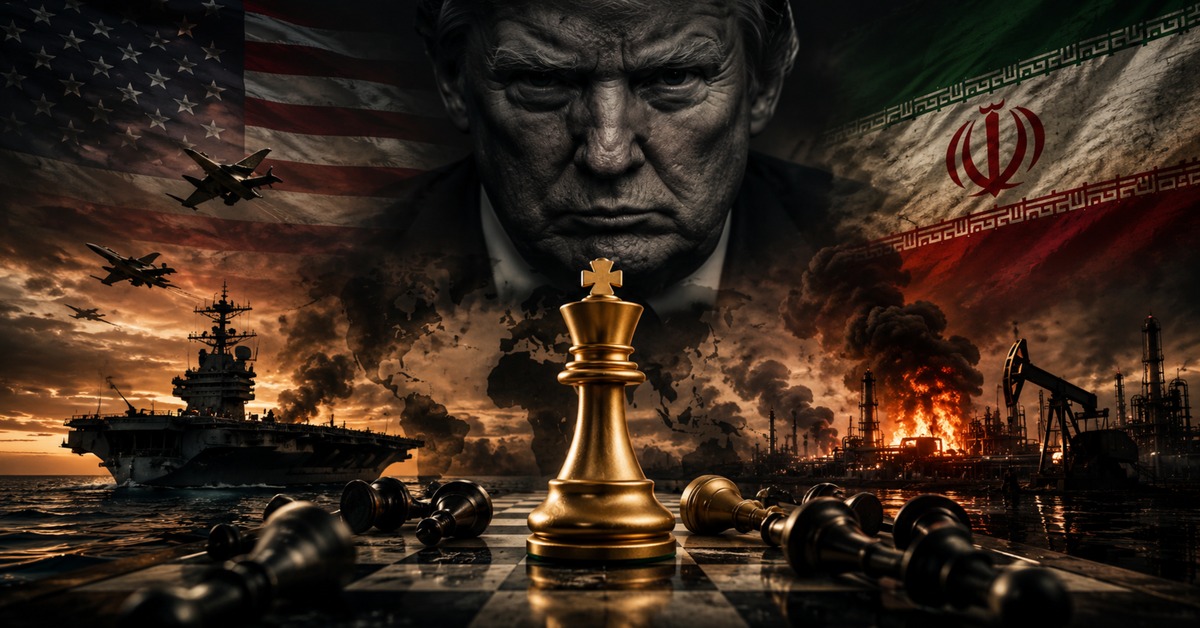
This broader strategy is where the phrase “5D chess” becomes important.
The term suggests that Trump is dealing with several connected problems at the same time. He is not simply fighting a conventional war against one government.
The first level concerns Iran’s political system. The source argues that the Iranian regime does not behave like a typical government. Its ideology influences nearly every important decision. That makes normal diplomatic assumptions unreliable.
The second level involves politics inside the United States. Negotiations and temporary pauses are sometimes interpreted as signs that Trump is backing down. The source says they serve a strategic purpose instead. Such moves may help control public reaction. They can also prevent divisions at home, settle energy markets, and give the president more room to act later.
The third level involves China and Russia.
The source argues that pressure against Iran also harms the countries that support it. Iran has provided China with discounted oil for years. It has also helped Beijing gain more influence in Middle Eastern affairs. If Tehran loses its regional power, China could lose an important source of energy and strategic leverage. That would damage Beijing’s position far beyond Iran.
The fourth level focuses on the internal stability of the Iranian regime.
Iran’s leadership is described as a system shaped by clerical control, corruption, rival political factions, and uncertainty about future leadership. Military losses and economic decline could make those internal disputes worse. The regime may not need to be removed through one massive attack. It could gradually weaken as pressure causes its own institutions to turn against one another.
The fifth level concerns the network commonly known as the “axis of resistance.”
This regional network includes Hezbollah, the Houthis, and Iranian-backed militias in Iraq. According to the source, it has already been losing strength for several years. The killing of Qasem Soleimani marked one major setback. Hezbollah later became weaker. Assad’s government in Syria eventually fell. Washington is now reportedly working to bring Iraq and Lebanon closer to the United States. The strategy does not attack Iranian influence in only one country. It attempts to reduce that influence throughout the region.
The main argument is that Trump’s strategy requires patience. It is not based on one spectacular military victory.
Critics often interpret negotiations or temporary breaks in military action as proof of hesitation. The source argues that these moments are part of the larger plan. The campaign reportedly uses military pressure while restricting Iran’s economy. It also isolates Tehran diplomatically. Internal problems are allowed to grow as Iran’s proxy forces lose their influence.
Under this interpretation, the apparent disorder may not be disorder at all. What looks confusing from the outside could be a calculated strategy designed to place Iran in a position from which it cannot recover. That is the reasoning behind the claim that Trump is working toward a long-term checkmate.
#trump #iran #middleeast