

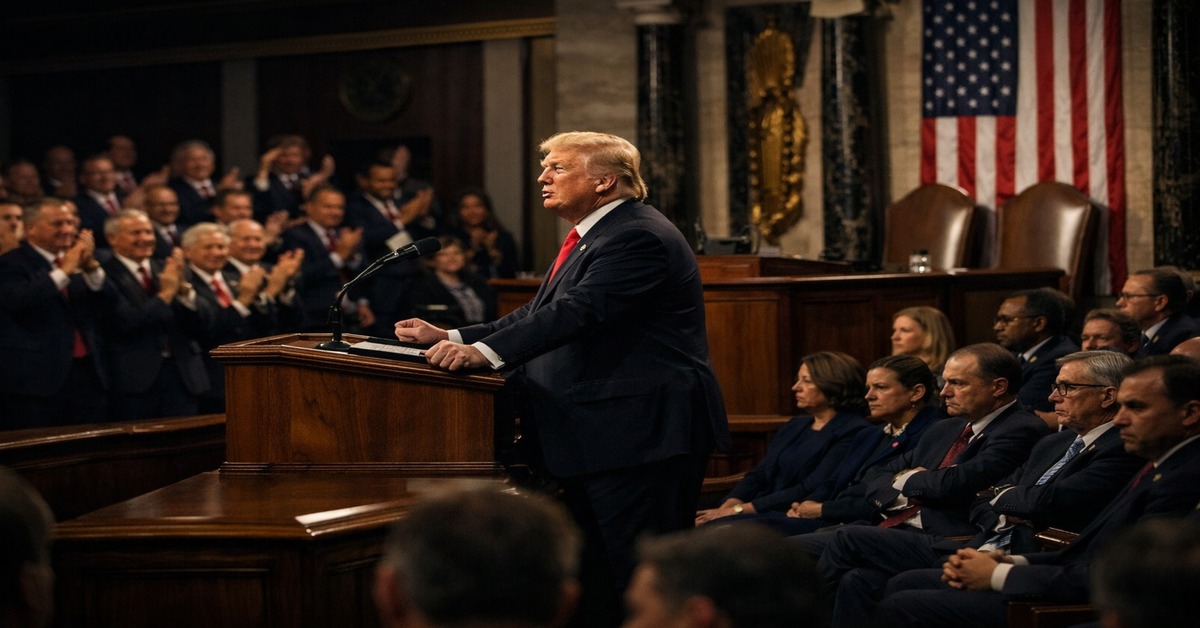
Last night was not just another State of the Union. President Trump walked into that chamber and, according to his supporters, executed a calculated political move that left Democrats exposed in front of the entire country.
From the outset, the mood inside the room was electric. The president wasted no time setting a firm and unapologetic tone. Representative Al Green was removed from the chamber for the second consecutive year. Representative Ilhan Omar showed visible emotion during the proceedings. Then came the moment many conservatives are calling the turning point of the evening. Trump posed a straightforward question that required a visible response, and the country watched how each side answered.
Those who support him described the address as a strategic victory. Even analysts on CNN conceded that the message connected with viewers, which suggests the speech reached beyond Trump’s core base.
The address lasted one hour and forty-eight minutes, making it the longest State of the Union in modern history. Trump filled that time by reinforcing the priorities that define his presidency. He spoke about economic growth, border control, public safety, and what he calls deep-rooted corruption in Washington. His language left no ambiguity about where he stands.
He opened by pointing to the upcoming 250th anniversary of American independence. He portrayed it as a defining moment in national history and framed the current period as a renewal of American strength. He called it the “Golden Age of America.” His tone conveyed certainty. His message projected confidence. In his view, the nation has regained its footing.
He then turned to specific policies. He cited what he described as historic economic performance. He honored American athletes and members of law enforcement. He sharply criticized Democratic leadership over immigration, crime, and rising costs. Television coverage frequently showed Democrats remaining seated during applause moments that energized Republicans. Those images carried political weight.
VISIT OUR YOUTUBE CHANNELThe evening’s most discussed exchange occurred when Trump stated that the first duty of the American government is to protect American citizens, not illegal immigrants. He asked those who agreed to stand in support.
Republicans stood and applauded. Most Democrats remained seated.
For Trump’s supporters, that split-screen image said everything. They believe it highlighted a fundamental disagreement about immigration and national responsibility. Republican strategists immediately recognized the campaign value of that footage.
The president continued pressing on sanctuary city policies. He called for strict penalties for local officials who resist federal immigration enforcement. He accused certain areas of protecting individuals with criminal records. He demanded action in firm terms.
Later, he addressed members of the opposition directly. He told lawmakers who chose not to stand that they should be ashamed of themselves. The tension was visible inside the chamber. Viewers at home could sense it.
Trump also introduced a new federal initiative aimed at combating welfare and social services fraud. He appointed Vice President J. D. Vance to oversee a task force designed to investigate billions in alleged misuse of public funds. The administration plans to begin in several Democratic-led states. Trump argued that recovering those funds could meaningfully reduce the federal deficit.
Post-speech polling indicated that a majority of viewers approved of the address. CNN data cited by supporters showed sixty-three percent reacted favorably, while sixty-four percent believed the outlined policies would move the nation in the right direction. Those numbers represented growth compared to polling taken before the speech.
Much of the speech centered on proposals that historically receive broad public backing. Trump advocated banning congressional insider trading. He proposed eliminating taxes on tips and overtime wages. He supported voter identification laws. He argued that violent offenders should remain behind bars instead of being released under cashless bail systems. He described these positions as practical measures supported by everyday Americans.
According to his allies, the strategy was straightforward. Focus on issues with strong public approval. Force the opposition to respond in real time. In their assessment, Democrats appeared disconnected from mainstream opinion.
Democratic leaders rejected that framing. They labeled the speech divisive and performative. They argued that it reduced complex policy matters into partisan talking points.
Whatever one’s position, the address marked an important chapter in the early stage of Trump’s renewed presidency. The atmosphere was strained. The reactions were intense. The political consequences will likely influence the coming election cycle.
Supporters view it as a display of authority and command. Critics view it as further proof that confrontation has replaced consensus in Washington.
One thing is clear. The speech has reignited debate about immigration, crime, fiscal oversight, and the nation’s direction as the United States approaches the milestone year of 2026.
#stateoftheunion #trump2026 #americafirst